Author: Diana Marin

  • Immersion. Expansion. Reverie.

    Having decided to embrace the unknown, we take confident steps forward, aware of our part in the greater design. Scent of ritual, sight of stars, and a refreshing breeze that revives us. The atmosphere takes us out of our formerly stagnant, limiting state. Everything is aligned perfectly. We are here for a purpose. We are here to forget some things and remember others. We are here to let go. To accept. To integrate. To be. Piercing eyes are not invasive here. Each soulful gaze feels like home. I can see myself in them. I am a vital part of something special and I can feel its grandeur, yet my core is still untouched, consistent. My focus is selective, the concept of pain is utterly nonsensical here- a faraway notion, neurosis removed, as each step gets me closer to a perception that I would have previously described as godlike. Pieces of narratives overlap, discourse becomes unnecessary. The power I could only vaguely fantasise about and partially conceive of before, becomes reality. In a total paradigm shift, the peaceful, blissful nature of an uncorrupted, spiritual power supersedes previous understandings of power, as it’s no longer conceived by a self that’s trapped in the temptation of existential nihilism or materialism or restricted by the limitations of an ego held captive by negative attachments.

    There is a sense of complete, beautiful harmony between body and spirit, as well as a liberating, soothing awareness that we are more than embodied selves. Yet we choose to experience our surroundings by inhabiting a body, even in this realm. Still, we have the power to make that choice, so we are now no longer confined to experiencing reality in merely one plane of existence, as consciousness merges with wholeness, with our eternal higher selves. We no longer process the world merely through our brains, on a physical level. I had a glimpse of this state before on a conceptual level, but back then I wasn’t fully in control, or at least the part I identified with and had access to wasn’t, and I felt pulled towards that state, perceived in a fragmented way.

    Back then, I recall it also felt like there was another presence inside me, a godlike presence I was having an inner dialogue with. I remember wondering– Is this God? The Devil? Someone from another world? Or am I a Goddess temporarily stuck in a human body with only a piece of my divine consciousness? (I used to identify as an agnostic with atheist tendencies) I couldn’t really tell if that presence was me, or something separate. It felt like something external, an ‘Other’, but at the same time like there was something of my self within this uncanny Other. We were communicating in a weird “language”. Through vibrations within. The presence was asking me or telling me something telepathically and if I resonated with what was said I would feel a sense of euphoria. Was that an unconscious mind process echoing religious beliefs I had drifted away from? The episode happened during an otherwise dark chapter of my life; For a long time, I have repressed it and avoided revisiting it because of the darkness associated with that time and because I needed to move on as I just wanted peace of mind. In an instance of curious chronological symmetry, towards the end of the same challenging life chapter, I had another episode involving an agonising amount of inexplicable physical pain. Ecstasy and agony. Like something entered me and a few months later it was purged.

    The doom and the gloom were perhaps aspects of a fragmented psyche, the experience itself couldn’t be separated from these haunting states of mind, since I experienced all of that through the filter of my consciousness. I attributed the experience to a fleeting disturbance in my brain, a glitch in the matrix of my otherwise sane mind, rather than one in the fabric of the universe as I knew it, because of my agnostic beliefs and because I couldn’t pinpoint the nature of it; yet I couldn’t stop thinking about it, hoping (and partly fearing) it had a greater connotation. Once the darkness no longer had power over me and I could remove it from my psyche, I redefined the experience, attributing a different meaning to it. I removed the absurd beliefs that were just echoes of trauma and I kept the mystical side in the hope that it was a first step towards experiencing spiritual awakening, an insight not solely generated by a deluded mind, rather a deeper truth about what it means to be human and about my journey. Because let me tell you, an agnostic leaning towards atheism does not feel at peace, especially when they are ego-led.

    By integrating the experience, I became more open to the mystery of existence, and implicitly to the possibility that consciousness can persist independently of the brain- a view that was a cure to my ontological obsession and to the despair brought by thoughts about death. Of course, I still had doubts eating away at my newly found existential relief: Was my experience a sign of shifting towards a higher level of awareness or did it not carry any more truth than some pathological psychotic state? And, more importantly, was I simply replacing one religious framework supporting the idea of a make-believe world beyond our brief life on Earth (that I was skeptical about) with a different belief supporting the same idea, but a refined, more acceptable version, anchored in eastern spirituality? Was I still ego-led, refuting at all costs the idea that there is no grand scheme of things or that humans are insignificant in the grand scheme if there is one (for me, existential transience implied insignificance no matter how accomplished or meaningful one felt their existence on Earth was; in fact, the more relevant and interesting someone was in life, the stronger I felt the tragedy of the fleeting nature of human life) leading a transient life on a floating planet- a wonderful planet that is, however, just a small piece among myriads of pieces making up the cosmos? The cosmos and the exact nature of our consciousness may indeed have been a mystery, but potentially nothing more than a result of a series of lucky accidents of physics? After all, to take a moral stance, there was so much suffering in our world, in this small piece of the puzzling cosmos. Could all that suffering ever really be part of a bigger plan? Could those horrifying people who moved away from kindness, towards sinister acts of inflicting pain on others ever be an extension of something as beautiful and awe-inspiring as the Source or oneness?

    Still, I had a sense of self-importance, which had always been unshakeable, even in my most nihilistic state. This had to transition into the realm of spirituality. Yet even when I became interested in spirituality, most of my beliefs were still anchored in science. I was still inclined to believe I was in control of most of the things happening in my life and the rest of the events were random rather than predestined or under divine control. Considering my glimpse into a higher self, I had to wonder: did that self have any power to influence what was happening in my current life, at any time? Could she act as a guardian angel? Or was it just that one ambiguous, interpretable intervention? I was on a quest, seeking a system of mystical esoteric beliefs that could meaningfully co-exist with science and make sense to me. At the same time, seeking to experience something extraordinary, “otherworldly” that didn’t “make sense” or only made sense from a spiritual perspective.
  • The New World

    With each brush stroke, she renders her exquisite features in an exceptional manner that only her unnatural talent can achieve, seemingly managing to capture both her celestial beauty and intoxicating essence. Willow’s hypnotic gaze and entrancing expressiveness always inspired and fascinated the artist. Their special painting sessions suspend time; paradoxically, although this is an outdated activity borrowed from the Old World, in the New World it’s one of the aspects which projects them in an almost nirvanic state. During such moments of transcendence, their connection is so intense that Luna forgets everything about her existential crisis and the experimental nature of their simulated environment.

    For a split second, she thinks she sees the trace of a wrinkle on her model’s face. She blinks and it’s gone. She smiles in relief, despite acknowledging her mind has been playing small uncanny tricks on her lately. This often used to happen in the Old World, so it’s almost nostalgic. She looks at Willow and wonders what it’s like to be created in the New World, with no recollection of other times and with restrictions in experiencing implanted memories. She can’t imagine existing without the previous versions of herself and her own memories. Perhaps she would be more at peace, but she would lose herself entirely. Luna is one of the few inhabitants of the New World who has a personal history spanning over such different chapters in human advancement and ontological posthumanism.

    When she reminisces about the Old World, there are flashbacks of her spending most of her days daydreaming about immortality. Unlike most of the people around her who were preoccupied with mundane things which distracted their attention from the fact that the end vibrated within every human being, for her it was a consuming obsession. She felt that everyone around her was in a state of delusional denial; in her case, even during moments of human happiness and fulfilment, there was always the underlying thought of the transience of everything. She was depressed over any sign of ageing. Situations that made other people feel nothing but happiness, such as extended family meetings, made her initially happy but often depressed because of the fragility of life. She felt pretty alienated in her concerns, as others around her held beliefs in ethereal notions of the spirit. Although at that point, the world had gone through the first shift, thus being populated by enhanced biological brains and bodies that significantly slowed down the process of ageing and magnified original human capabilities, it was still ephemeral. Years later, after the Whole Brain Emulation process, she was over the moon. At first. She awakened, after all, still feeling like herself- an enhanced version of herself, of course, but the essence was there. She had been extremely worried that the uploading process would go terribly wrong and she would end up in extreme pain or simply erased. Her joy after finding out her WBE was successful was amplified beyond human levels. As promised, her senses, cognitive abilities, talent, and pleasure were enhanced. Later on, with her artistic skills and advanced knowledge of neuroscience and AGI research, she designed Willow’s physical appearance and mental configuration. They explored the wonders of the New World together. However, a secret kept haunting her. Luna concealed an important aspect regarding the creation of Willow […]

  • Characters’ psychology

    Both inspired by and afraid of her ineffable power to rise again and again, ever stronger, and pierce the essence of everything, he doesn’t know what he feels. She is wonderful. She is terrifying. She gives the impression that she is slightly aware of it, but not in a conceited way. In a playful way. In a way that makes you see the world as wonderful and terrifying. She is wild. She can’t be tamed. She has a rich, specific belief system, and yet she never wastes an opportunity to explore and gain new insights. It’s a rare occurrence for her to consistently dream about another person, but when she does, it can get pretty intense. And it must mean the other person is wonderful too. And yet she doesn’t want another person to become her world. Her world is thrilling, mostly safe but occasionally dangerous, fluctuating between periods of unpredictability and order. She is not necessarily a thrill-seeker, but a huntress of good feelings and of the sublime, the marvellous, the ethereal, with a relentless desire to feel alive. She likes being in control and having freedom. Her resplendent mind transcends boundaries. Her defining characteristics are creativity and a natural inclination towards divergent thinking. As we know, there are both advantages and disadvantages to this, just like everything else. Whilst brainstorming, coming up with a myriad of ideas and generating stimulating thoughts is highly desirable, her tendencies also make it difficult to have a structure in life, to focus on one thing at a time. A successful project requires you to eventually switch to convergent thinking, to stick to a strategy. Her inner life is a film with a non-linear narrative. He is different, in this sense, there is a promising duality between them. Since they play in different films, there is no way to tell if their narratives can harmoniously intertwine. Time will tell.

  • Not I

    “Not I”, Samuel Beckett, 1972.

    The character from “Not I”, Mouth, is a fragmentary woman whose neurotic speech is rapid, incoherent, and disruptive. She tells us about her loveless, emotionless past, reminiscing about how she led a dull uneventful life until a significant moment in April. This is one of the few moments in the play when there seems to be a glimmer of hope for her, a way to define her identity. If we think of T. S. Eliott’s “The Waste Land”, April is a month of regeneration- “breeding lilacs out of the dead land, mixing memory and desire.” Mouth had lived her entire life in a wintry state of silence, anhedonia, and inertia and this special, obscure moment in April generated her uncharacteristic discourse. There are many possible interpretations for the play- Absurdists tend to only create the flame to encourage us to find our own way in the darkness. The spectator can speculate on her state as being a bleak conception of the afterlife- She seems to be in a purgatorial state, awaiting her judgment. The character- referred to as Mouth- can also be seen as an actress with an identity crisis. Some elements are reminiscent of Ingmar Bergman’s film, Persona (1966), which also deals with bleakness, neurosis, and death.

    The writer of the Theatre of the Absurd is usually someone entrapped in their own inner world, trying to express existential anxieties in a congruent form. The plays move away from mirroring society personas toward portraying the nonsensical nature of human existence. Whilst existentialists approach the same theme in a philosophical, logical, and complex way, absurdists believe that the devaluation of language is essential to depict the absurdity of life. Words are insufficient and sometimes unnecessary, which is one of the reasons why Beckett often preferred silence to conversation, in his interactions with James Joyce in Paris: “They engaged in conversations which consisted often in silence directed towards each other, both suffused with sadness, Beckett mostly for the world, Joyce mostly for himself.” The two artists share the same existential anguish and that Baudelairean view of the modern world as an age of the ephemeral and the contingent.

  • Her Rebirth

    Haunted by Ophelia’s phantom,
    enraptured by vernal murmurs,
    she succumbs to dreaminess
    lost in the stream
    of consciousness
    carried away by Woolf’s whispers
    and echoes of myth from
    a scent of white Narcissus-
    fluid nostalgia in full bloom-
    she remembers her touch
    before the plunge;
    the sacred memory shatters
    underwater-
    her pale skin resurfaces-
    she is beaming;
    her alter ego withers
    underwater
    Nature witnesses
    an act of self-love.

  • An allegory

    Let your mind paint a rainy cityscape. A girl dressed in black, with a mask and noisy heels steps on the sidewalk. Her tears merge with the raindrops. Each tear encapsulates an entire mini-universe, lingering on her cheeks, like undetectable tokens of fluid vulnerability. A stranger passes her by, closely. His slightly curious, slightly worried gaze briefly meets hers. That’s when she remembers she’s in a public space: Maybe the distress in her eyes was visible, after all. His face doesn’t show pity, which is fortunate, for she hates pity – she’s always been too proud for it. But maybe she misinterpreted his facial expression and it wasn’t really concern. Maybe he misinterpreted her expression as something else too. He reminds her of someone – someone kind, sweet, wise, and very dear to her. Someone who knew how to unleash her vulnerable and dreamy side simply by being himself. The rare realness of this person was always rewarded with the privilege of meeting all the facets of her personality.

    What her expression conveyed was grief. All-consuming grief, manifested as an affliction of the mind and the body. The inner chaos-intense, the body-tense, during the painful procession. Towards the funeral of the distilled dreams of being. Still alive are the hopes to resurrect the dreams the next day. Another dream, of inner peace, is born. She is wondering when it will materialise. Meanwhile, sweet echoes fill the mind as background music, sung by the Light Beings, ‘Talent. Creativity. Intelligence. Beauty. Resilience. Strength. Kindness’ This is not your typical funeral song. This is one of those days when the melodic discourse is played like a mantra to assuage the mind, to overpower the inner wailing from the funeral rite, to self-induce good vibes, in order to help her keep putting one foot in front of the other foot instead of collapsing. Like an incantation, to banish other toxic thoughts. It’s one of those days when other aspects resonate too strongly, sucking the power out of the good ones, and releasing dark energy. These other forces are not as clear. The noise they express themselves in is a sort of gibberish, a chaotic, harmful nonsense, inducing a heaviness of the heart.

    There are rooms she doesn’t unlock in her mind, because she doesn’t want to let the poison out. She wants to stay pure. Untainted. One room contains dusty effigies of blacklisted figures. They’re not distinctive or intelligible, they’re merged into each other, shape-shifting embodiments of damaging thoughts. They are all locked away together in a claustrophobic space, drenched in darkness. Poison drips from their mouth as they breathe in the poisonous atmosphere like zombies. Meanwhile, The Light Beings roam in their perfumed, elegantly decorated chambers inside the mind, as companions and guardians. The Light Beings are personified thoughts, but also real-life people. When she dissociates, it’s probably so as to stay away from the poisonous atmosphere when the forbidden door malfunctions. That poison rarely affects anyone else, besides her self, it is confined within her being.

  • Soulmates

    Do you believe in soulmates?

    I believe there are people with whom you can share a strong, profound, mutually fulfilling, loving bond (not exclusively of a romantic nature), and that this type of connection has the potential to enhance the lives of those involved by enriching their perspectives in life, as well as helping them feel inner peace and become better versions of their authentic selves. This requires mutual transparency, vulnerability, and, implicitly, trust. You can explore the depths of your souls (or minds, if you prefer) and find delight and substantial meaning in your explorations.

    I believe in serendipity. I acknowledge the importance and influence of brain chemistry and mental configuration in experiencing soul connections, the ontological subjectivity that requires us to design and give meaning to everything, to every encounter, every thought about others, every experience. I believe that when it comes to profound connections, this design really fluctuates from person to person, because of both nature and nurture (literature, philosophy, exposure, upbringing, family models, attachment theory), but that we can all find relatable ways to describe these intimate experiences, although language is ultimately limiting. I believe in passion. And I believe that sometimes passion can be a fleeting thing, and it can also be associated or confused with obsession (limerence) or infatuation.

    However, I’m not fatalistic, I don’t really believe in destiny; I don’t believe or agree with the view that you are incomplete and need to seek your other spiritual half – even though some people function better and grow within a (healthy) relationship. Self-development and awareness can be achieved outside a conventional romantic formula, and outside the parameters of romance altogether (through art, spirituality, hobbies, your career path, etc). I would also deem a mentor, an academic tutor, a friend, or a family member as my soulmates, depending on how well we connect and how inspired or close to my authentic self I feel when I’m around them.

    I also don’t believe strong, meaningful bonds need to persist throughout time or be lifelong in order to be valid, impactful, or life-changing. What I do believe is that each human being ultimately creates their own meaning and narrative in life, and for many people, the concept of soulmates makes a lot of sense in the way they construct their world, as they’re more likely to reach their potential that way; and poetic, dreamy souls may attribute otherworldly or cosmic connotations to this connection. There is always the other side of the coin- some people tend to ‘lose themselves’ in a relationship, in which case it’s better to nurture your soul first in other ways.

    Personally, for the majority of my life, I have found myself on a paradox-resembling spectrum, between a dominant rational view on this subject & a poetic one, with a tinge of romance and magical realism and sprinkles of “je ne sais quoi”. Ultimately, in my case, intellect tends to rule over my feelings, and even my feelings seem to go through the filter of my intellect first. What I aspire towards is love in a wide sense, as a state of being and seeing and relating to the world.

    It would be amazing if love surpassed fear as the driving force in the world, if people were not maneuvered by their shadows and emotional baggage. The first step is acknowledging this aspect. And then, the harder part, is re-structuring the mind in your favour, to form beneficial patterns. To get back to the topic of romance, whenever I think about or try to describe my thoughts vis-à-vis romantic connections, my discourse comes across as ambiguous, even contradictory, and that’s because of that area of “je ne sais quoi”- I find this hard to describe. It’s one of those things where I tend to know it when I see it or live it; where a new experience might shape a different answer, or my perspective might shift when I enter a different chapter of my life in which this aspect will be re-contextualised.

  • Films with an oneiric structure

    Films with an oneiric structure

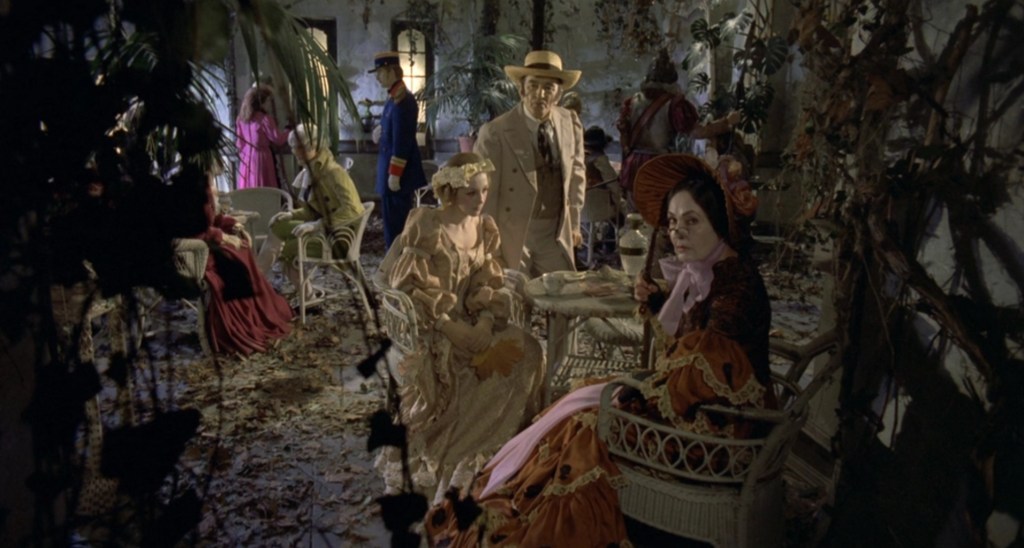
    The Hourglass Sanatorium / Sanatorium pod Klepsydra (1973) is a mesmerising, hallucinatory Polish film directed by Wojciech Has, unfolding like a dream with a playful narrative and poetic contemplation on life, time, and feelings of déjà-vu. Once he enters the peculiar, decaying setting of the sanatorium to search for his father, the protagonist goes on a transformative journey through a chaotic mix of dreamscapes in a surreal world where dreams merge with memories and fantasies- a world that is inhabited by uncanny figures.

    Valerie and Her Week of Wonders / Valerie a týden divu (1970) is a Czechoslovakian surrealist horror/ fantasy film directed by Jaromil Jireš. The sometimes ethereal and dreamlike, at other times uncanny and nightmarish whimsical fairy tale of death, religion, and lurid sexuality, subversively depicts the adventures of Valerie, a young girl passing through mesmerising, disorienting episodes featuring vampires, a particular frightening, demonic figure somewhat reminiscent of Nosferatu, priests, nuns, and perversions. The moments unfold like symbolic manifestations of the unconscious, the Freudian subtext being Valerie’s sexual awakening.

    House / Hausu (1977), dir. Nobuhiko Ôbayashi, is a Japanese lurid surreal comedy horror film characterised by a vivid colour palette, disorienting images, and supernatural events conveyed through peculiar editing and special effects. The atmosphere summoned up by a captivating mix of magical shots provides a wild cinematic experience, evoking dream states. Inspired by unconscious fears of a strange playful nature, featuring disembodied fingers playing a carnivorous piano, an antagonistic cat, and a mischievous flying, severed, biting head, the strange narrative follows a girl called Gorgeous and her classmates as they get caught up in chaotic phenomena inside the haunted house of the protagonist’s aunt. The line between fantasy and reality, as well as the one between the sinister and the playful become blurred.

  • Inner discourse

    I have always wondered what other people’s inner lives are like. Some of my greatest strengths are my perceptiveness and empathy, so I can quite easily figure out what someone is feeling, how they are likely to react, or what I should say in order to make them respond a certain way. Then again, maybe that is delusional, or surface-level stuff. Ultimately, you don’t really get to know what other people’s inner voices and discourses sound like and how they piece together their narrative. (Don’t even get me started about the unfathomable unconscious)


    My external life isn’t something I tend to write about, in any direct way, as it seems quite uneventful. My inner life has always been complex. One thing I used to dream about was eternal life, as a sci-fi narrative (i.e. uploading our consciousness into an eternal body or merging with AI), rather than in a religious sense. This is a polarising subject: some are horrified by this, others see the positive side of living forever, in whatever way. Since I always felt that those unafraid of – even at peace with – death were made of a different substance from myself, I used to be part of the latter category, thinking it would be amazing to find a way to preserve my consciousness, what makes me who I am, somehow. Yet I had never viscerally contemplated how the elusiveness of this ontological concept can work against such futuristic dreams, turning them into frightening dystopias.


    There have been a few shifts in my inner world. One was spiritual, taking me on a path of Enlightenment. It gave me a distinctive sense of control and harmony. Unfortunately, it was a transient feeling, experienced whilst reading a book on a relevant subject; yet it offered me a glimpse of another perspective, another lens to see and feel the world through – one that was free of worries and other negative attachments. As opposed to the mental state of an emotionally detached person to whom you could also attribute the previous description, what I am referring to is on a different wave length; it’s not emotional distancing or numbness. It’s acceptance, surrender, experiencing the lightness of being, and the sense of inner peace and control arising from that state. It must be amazing to live your whole life that way, as people who fully dedicate their life to esoteric knowledge, practices, and meditation do. Although in my case it was ephemeral, recalling the experience, knowing that it is possible to view life through that filter still marked a long-term shift in my world view, albeit less impressive than the actual experience. Similar life-changing shifts have been experienced by people on prescribed pills such as anti-depressants. A second, poetic shift happened after watching a film that constituted an uncanny experience which temporarily projected me into a derealised world. The same type of experience was repeated at a later point, in other, rather peculiar circumstances, which I will not elaborate on in this.


    I look at neighbouring houses and sometimes see unknown, pensive faces behind windows. Thoughts and narratives about their inner lives form and dissolve. Enlightened masters say We are One, but our egos (in Eckhart Tolle’s use of the word, his view of ego as the self that’s stuck with negative attachments and patterns rather than the psychoanalytic use of the word) separate us. E. Tolle says true compassion for and deep understanding of other human beings are based on the acknowledgement of the duality of our ephemeral-eternal nature. I don’t know if I believe in eternity in a spiritual sense. It seems likely, though, that if we manage to transcend life and our egos, we will supposedly be at peace with everything.

  • Three colours: Blue – An Uncanny Emotional Landscape

    Three colours: Blue – An Uncanny Emotional Landscape

    Three Colours: Blue is the first film from Krzysztof Kieślowski‎’s atmospheric, intriguing, evocative Three Colours trilogy. The enigmatic arthouse masterpieces explore different facets of the human condition with a refined sensibility and aesthetic elegance. The three films have been interpreted as an anti-tragedy, an anti-comedy, and an anti-romance by Roger Ebert. The symbolism behind Three Colours: Blue, White, and Red refers to the French flag and the values associated with each colour- liberté, égalité, fraternité- the national motto of France. Each colour is also significantly connected to the mood and mental state of the characters.

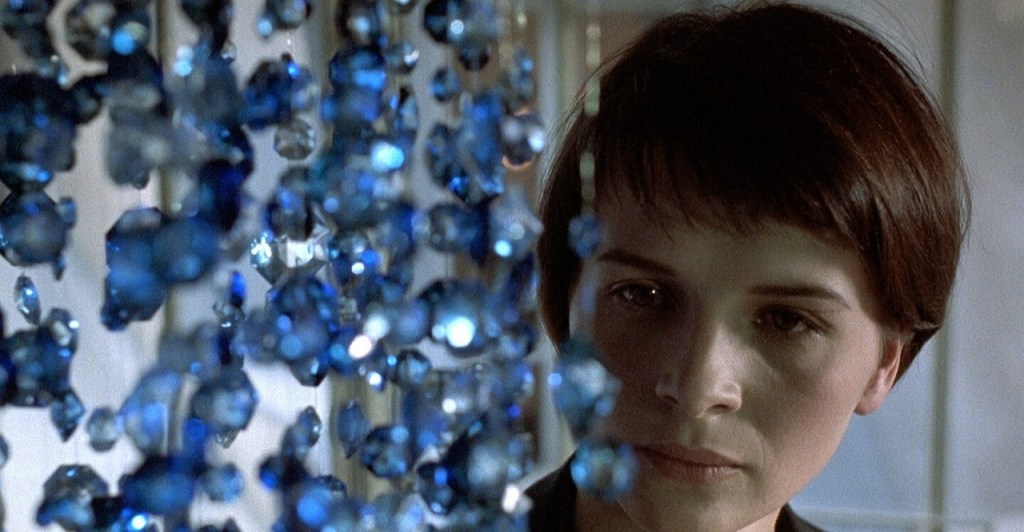
    Three Colours: Blue is a moving cinematic tale about death, grief, rebirth, and (emotional) freedom, conveyed through gripping, poetic cinematography and a hypnotising, frisson-inducing soundtrack by Zbigniew Preisner. The film starts on a grim note, within a bleak landscape. Julie, one of Binoche’s most powerful and profound performances, is a strangely compelling character who goes through a life-changing traumatic event, which projects her into a perpetually solipsistic state. The story is an exploration of the psychological metamorphosis a young widow goes through as a trauma response. Although she seems derealised, absent-minded, and in a trance, there is something about Juliette Binoche’s performance that entrances viewers, allowing us to form an emotional connection to an emotionally disconnected character.

    The cold colour palette of the film matches the veils of numbness and depression the protagonist initially wraps herself in whilst suppressing her sorrow in a period of mourning. Both present and absent, alive yet emotionally unresponsive, Julie seems to inhabit an uncanny emotional landscape, which is reflected through soul-stirring cinematography. The soft, ethereal blue lights Julie’s face is often bathed in are used to explore and evoke her feelings and memories. In an attempt to set herself free from the dark clouds she is surrounded by, to escape the heavy burden of grief, the despondent protagonist decides to sell her house and all her possessions, make financial arrangements for her mother and her staff, burn her dead husband’s musical compositions, and start a new life. Whilst she initially seeks a superficial sense of freedom emerging from breaking ties with her past, with everything and everyone in it, and from the anonymity of moving to a new place in Paris, she eventually reconnects to the lightness of being.