Category: literature

  • A glimpse into the NDE in “Proof of Heaven”

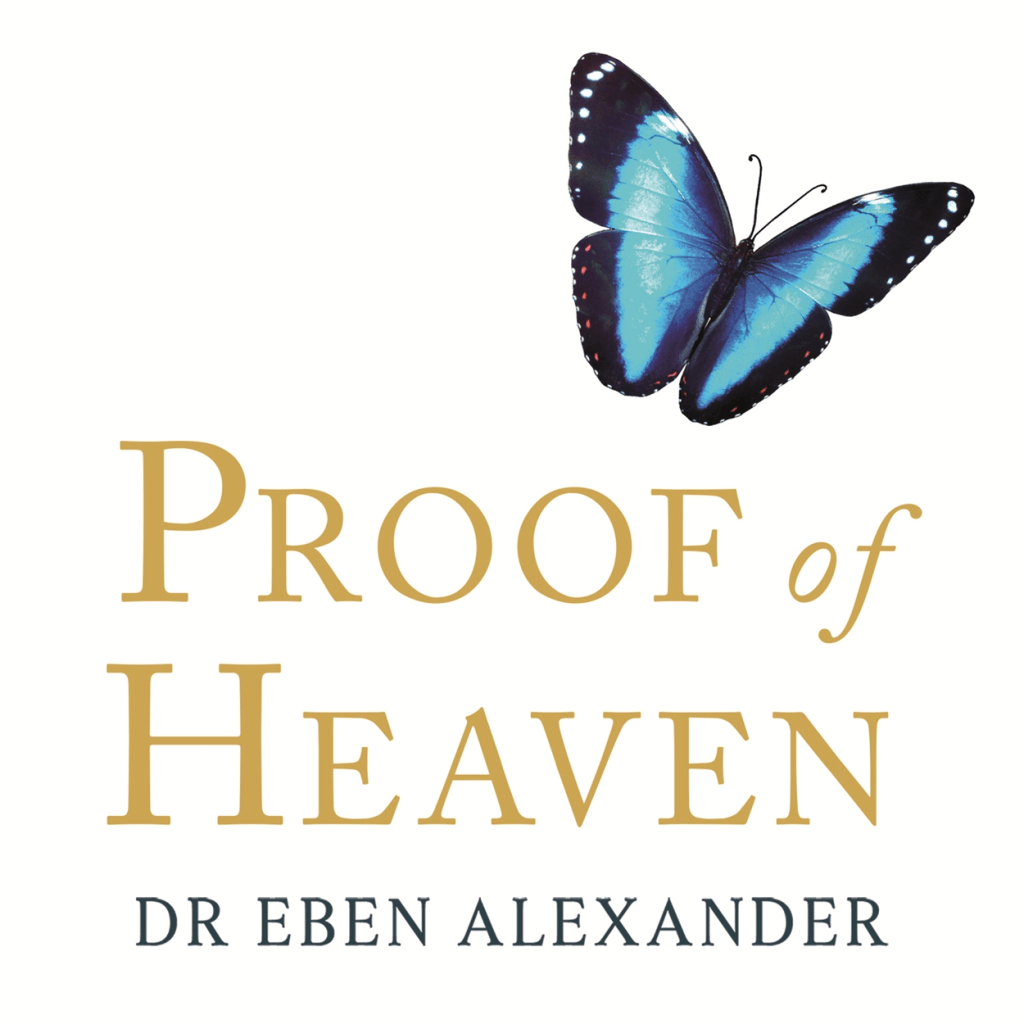
    I’ve recently read Proof of Heaven: A Neurosurgeon’s Journey into the Afterlife, by Dr. Eben Alexander, who documented a miraculous experience that led him to believe that the death of the brain and of the body doesn’t constitute the end of existence, that consciousness lives on after death and god exists and loves all beings. He dedicated this book to people like him (and me) who are sceptical about NDE recollections. As someone with an obsessive preoccupation with the subject of NDEs and insights into occurrences that hint at the phenomenon of consciousness existing independently from the brain, I’ve had this one on my reading list for a while. The way the narrator describes his communication style in the idyllic world he visited is not unlike my own transcendental experience from some time ago: wordless, felt, almost telepathic, and ineffable.

    The narrator views his NDE as a life-turning event that led to a metamorphosis of his life as he knew it, due to a very significant paradigm shift regarding a fundamental belief. As a firm believer in science, although hoping to be proven wrong, he had always aligned with the view that the brain equals consciousness, that once the neocortex is switched off, the possessor vanishes into non-being. He had read many recollections of NDE subjects who claimed to have navigated otherworldly landscapes or talked to god during their experiences, but he always thought such instances were still brain-based, that they happened whilst the brain was not totally shut down – for instance, if someone’s heart was temporarily off and their neocortex was inactivated for a while yet not irreversibly damaged and irretrievable. That was before he was afflicted with a very rare case of bacterial meningitis and, whilst in a coma and with a completely inoperative neocortex – as he claims, the deeper part of him – that he had previously described as existing beyond time – deserted his body and his mortal identity, including his memories and his self-concept, to wander into other realms, meet otherworldly beings, have a conversation with god, and have glimpses into higher dimensions.

    During his comatose metaphysical odyssey, he delved into the Underworld, the Gateway, and the Core, places that he was convinced were real.

    The Underworld was characterised by “Darkness, but a visible darkness-like being submerged in mud yet also being able to see through it. Or maybe dirty Jell-O describes it better. Transparent, but in a bleary, blurry, claustrophobic, suffocating kind of way. Sound, too: a deep, rhythmic pounding, distant yet strong, so that each pulse of it goes right through you. Like a heartbeat? A little, but darker, more mechanical-like the sound of metal against metal

    Whilst in this pulsing underworld, his consciousness was devoid of memory or concepts of identity, his existence was not limited by time, and he felt like his awareness was uncannily merging with his surroundings. In a way, the experience was dreamlike, as he could perceive what was happening around him, without having any self-concept. He didn’t have a body or at least the awareness of one, or the capacity to form words. It felt like he had regressed to a primordial state, he ponders, as far back as the bacteria that infected him, causing his illness – in a world devoid of emotion, logic, and language.

    The traveller’s extremely apathetic predisposition gave him a certain invulnerability, due to his detachment from his memories and sense of self. Although he could judge that he may or may not survive that place, thoughts of either option caused nothing but indifference.

    The narrator mentions this underworld dwelling was like being inside a murky womb with bloody vessel-like ramifications of a dirty scarlet aglow, or like being buried underground yet still able to see the matrixes of roots.

    I am going to include his entire description of the place, because I feel it is a great image of an uncanny liminal space:

    “The longer I stayed in this place, the less comfortable I became. At first I was so deeply immersed in it that there was no difference between “me” and the half-creepy, half-familiar element that surrounded me. But gradually this sense of deep, timeless, and boundary less immersion gave way to something else: a feeling like I wasn’t really part of this subterranean world at all, but trapped in it.

    Grotesque animal faces bubbled out of the muck, groaned or screeched, and then were gone again. I heard an occasional dull roar. Sometimes these roars changed to dim, rhythmic chants, chants that were both terrifying and weirdly familiar-as if at some point I’d known and uttered them all myself.

    As I had no memory of prior existence, my time in this realm stretched way, way out. Months? Years? Eternity? Regardless of the answer, I eventually got to a point where the creepy-crawly feeling totally outweighed the homey, familiar feeling. The more I began to feel like a me—like something separate from the cold and wet and dark around me—the more the faces that bubbled up out of that darkness became ugly and threatening. The rhythmic pounding off in the distance sharpened and intensified as well—became the work-beat for some army of troll-like underground laborers, performing some endless, brutally monotonous task. The movement around me became less visual and more tactile, as if reptilian, wormlike creatures were crowding past, occasionally rubbing up against me with their smooth or spiky skins. Then I became aware of a smell: a little like blood, and a little like vomit. A biological smell, in other words, but of biological death, not of biological life. As my awareness sharpened more and more, I edged ever closer to panic. Whoever or whatever I was, I did not belong here. I needed to get out. But where would I go? Even as I asked that question, something new emerged from the darkness above: something that wasn’t cold, or dead, or dark, but the exact opposite of all those things. If I tried for the rest of my life, I would never be able to do justice to this entity that now approached me . . . to come anywhere close to describing how beautiful it was. But I’m going to try.”

    The being of light he continues to describe was spinning, emitting shiny, white-gold filaments causing the darkness enveloping the protagonist to fracture and disintegrate. Eventually, the whirling light revealed an opening, a portal that the traveller went through, feeling like being born into an idyllic, blissful world, where the inside and the outside were intertwined and where he also experienced uncanny feelings of déjà vu.

    “Below me there was countryside. It was green, lush, and earth like. lt was earth, but at the same time it wasn’t. It was like when your parents take you back to a place where you spent some years as a very young child. You don’t know the place. Or at least you think you don’t. But as you look around, something pulls at you, and you realize that a part of yourself-a part way deep down-does remember the place after all, and is rejoicing at being back there again.”

    The narrator continues to emphasise the realness of the place throughout the dreamlike descriptions. He also describes “the single most real” experience of his life: an encounter with a girl who communicates a special, soothing message to him by transferring its conceptual essence into his mind, wordlessly. Whilst acknowledging the limitations of earthly language, he translated the message as such:

    “You are loved and cherished, dearly, forever.”

    “You have nothing to fear.”

    “There is nothing you can do wrong.”

    Inside the Core, advanced, ethereal, winged beings, scintillating creatures with silvery bodies, living sounds, and an elusive divine being blessed the surroundings. Everything was part of Source. After silently asking questions such as “Where is this place? Who am I? Why am I here?”, he mentions that “the answer came instantly in an explosion of light, colour, love, and beauty that blew through me like a crashing wave. What was important about these bursts was that they didn’t simply silence my questions by overwhelming them. They answered them, but in a way that bypassed language. Thoughts entered me directly. But it wasn’t thought like we experience on earth.”

    This part was what struck a chord with me because of my own experience of transcendence. There is an uncanny resemblance between my own otherworldly encounter and the excerpt above, particularly the communication style, which is something that I’ve written about on my blog at some point and in my diary more extensively, and our words seem to describe a similar encounter – albeit with an extra element that was pretty essential in mine. It’s also relevant to say I was not in a coma or on DMT, and there were no perceptual hallucinations, it was an intense inner feeling whilst I was caught somewhere between worlds.

    I would love to end this on a positive note and to say that this book will convert your world view on matters of the afterlife. Naturally, however, despite the credentials of the author, I was inclined to take the subject of his writing with a grain of salt, especially in regard to the moment when the NDE happened. I was so excited about this non-fiction book because it was written by a neurosurgeon who expressed his belief in science throughout it, as well as confidently asserting that his conclusions were grounded in medical analysis of his experience and on his deep familiarity with the most advanced concepts in brain science and consciousness studies. Normally when I read about NDEs, they often appear intertwined with the notion of a DMT-induced hallucination and there remains an unresolved issue of whether the voyage to alternative realms occurred during the coma or immediately before or after it, which is more scientifically plausible. This makes sense, especially considering the numerous cases of people who have miraculously awakened from extended comas, only to confirm that they only encountered nothingness beyond. There have been neuroscientists who also discredited the supernatural element of Dr Eben Alexander’s story, saying it was unscientific and justifying it using the same explanation I mentioned. One of the doctors involved in his case also stated that Eben was hallucinating before he went in a coma.

    And I understand and still feel the scepticism. However, because of my experiences, I must say this story opens up that door of the esoteric inside my mind a little bit wider. I shall see if reading Dr Raymond A Moody will have the same effect.
  • Not I

    “Not I”, Samuel Beckett, 1972.

    The character from “Not I”, Mouth, is a fragmentary woman whose neurotic speech is rapid, incoherent, and disruptive. She tells us about her loveless, emotionless past, reminiscing about how she led a dull uneventful life until a significant moment in April. This is one of the few moments in the play when there seems to be a glimmer of hope for her, a way to define her identity. If we think of T. S. Eliott’s “The Waste Land”, April is a month of regeneration- “breeding lilacs out of the dead land, mixing memory and desire.” Mouth had lived her entire life in a wintry state of silence, anhedonia, and inertia and this special, obscure moment in April generated her uncharacteristic discourse. There are many possible interpretations for the play- Absurdists tend to only create the flame to encourage us to find our own way in the darkness. The spectator can speculate on her state as being a bleak conception of the afterlife- She seems to be in a purgatorial state, awaiting her judgment. The character- referred to as Mouth- can also be seen as an actress with an identity crisis. Some elements are reminiscent of Ingmar Bergman’s film, Persona (1966), which also deals with bleakness, neurosis, and death.

    The writer of the Theatre of the Absurd is usually someone entrapped in their own inner world, trying to express existential anxieties in a congruent form. The plays move away from mirroring society personas toward portraying the nonsensical nature of human existence. Whilst existentialists approach the same theme in a philosophical, logical, and complex way, absurdists believe that the devaluation of language is essential to depict the absurdity of life. Words are insufficient and sometimes unnecessary, which is one of the reasons why Beckett often preferred silence to conversation, in his interactions with James Joyce in Paris: “They engaged in conversations which consisted often in silence directed towards each other, both suffused with sadness, Beckett mostly for the world, Joyce mostly for himself.” The two artists share the same existential anguish and that Baudelairean view of the modern world as an age of the ephemeral and the contingent.

  • A close reading of Sappho: beyond the erotic

    Sappho, the first notable female interpreter of the human soul to speak her mind through lyric poetry, is a symbol for women’s self-assertion, as well as the inventor of romantic imagery that has since become common and often used in our culture. The reader who enters the Sapphic realm will be initiated into an atmosphere of ritual, ecstasy, contrasting outpouring of emotions, all of this being both concealed and revealed by fragmentary, yet vivid aesthetic descriptions of a nature inspired by the Lesbos Island. Sappho’s poems seem to reflect the balance of Apollonian and Dionysian essence that characterises art, in Nietzsche’s view. The Apollonian nature of her work lies in the beautiful, evocative and musical forms and structures of poetry, while the Dionysian is represented by the powerful underlying emotions and experiences.

    Focus on sensual and emotional awareness
    While the theme of love is essential in Sappho’s writing, this should not be reduced to the elements of lust, desire, or to assumptions about the author’s homoerotic passions, as it happened during the Victorian Era. Her work is concerned with sensuality, with a disintegration and reconstruction of the senses and with the bittersweet nature of love. The purpose of this poetic sensuality, as stated by Judith Halleth, is to act as a social means “to impart sensual awareness and confidence in young females on the threshold of marriage and maturity” and to encourage the development of female identity. While Stehle argues against this, saying that the personal intimate reality in Sappho’s work is the most important, it is fair to say that there is a connection between the private and the public in Sappho’s world and in her poetic intentions. On the same note of inspiring sensuality, Josephine Balmer also believes that “Sappho’s poetry is sensual and emotional rather than sexually explicit”. In poem no 32 for instance, in which the narrator shares memories of past bliss with a tone marked by the suffering of parting with the lover, there is an emphasis on the senses: The surroundings radiate sensuality. Elements such as the flowers (violets, roses and crocuses), the floral scented perfume, the garlands and the bed are all associated with the notion of love and depict the relationship between the two lovers in terms of colours and scents.

    Ritual imagery
    The Dionysian atmosphere of ecstasy that encourages revelling in sensual pleasures is present throughout several poems, such as no 79 in which Sappho creates her ideal image of the temple of Aphrodite, seeming to describe a paradise ruled by a mix of haunting perfume, beautiful pastoral landscape dominated by flowers and the soothing sound of rivers, finishing with a very vivid simile and metaphor of pouring “like wine into golden cups,/ a nectar mingled with all the joy of our festivities”. Wine is a characteristic of ritual imagery, as well as a fundamental Dionysian element in its perception-altering effect. The feelings conveyed in the poem can be resumed in Baudelaire’s famous line from Correspondances, “Les parfums, les couleurs et les sons se répondent”.

    Connection between the Sensual and the Spiritual
    The sensual is closely related to the spiritual in Sappho’s poetry. There is a spiritual dimension to Sappho’s love, which is reflected through the rituals of worshipping the Goddess of Love. Her Ode to Aphrodite imitates a prayer, similar to a Homeric one, in which she begins by invoking the goddess and describing a previous encounter; and finishes symmetrically, in a ring composition, by asking her to come again. Sappho’s description of the previous spiritual encounter is very evocative: it seems to flow perfectly, encouraging the reader to visualise and re-live her experience. The description ends by switching from an indirect approach to a direct one through which Aphrodite asks in a non-hesitant, straightforward manner: “Who shall I persuade this time/ to take you back, yet once again, to her love;/ who wrongs you, Sappho?”.

    The figure of Aphrodite
    Aphrodite’s tone is very familiar and impatient, because of the repetitive reason of the invocation, namely regaining a lover’s affection. Some critics saw the tone of the ode as “an expression of the vanity and impermanence of her passion, composed in a spirit of self-mockery ”. From this perspective, Aphrodite appears to remind Sappho that all pain is ephemeral and that time will heal all wounds. However, the power of the goddess of love is strongly emphasised in the poem in the sixth stanza by listing the three inversions that are about to happen: instead of running away from, the beloved will run after Sappho, instead of shunning gifts, she will give, and even against her will, she shall love Sappho. The structure and content of the poem makes it difficult to tell whether it was meant to be performed in public or in private. It is said it might have been performed as part of the cult of Aphrodite, but the way Sappho addresses herself in the fifth stanza through Aphrodite’s voice, together with the intimate sense we get from the invocation, gives the impression that it was private. This personal use of myth is one aspect contributing to Sappho’s originality, and it is depicted through the lyric form of her poetry, which is focused on individuality.

    Adopting epic language within a lyric context
    In her description of Eros, Sappho employs Homeric terms such as “limb-relaxing”. Her poetry gives new meanings to the epic language. Sappho transforms Homer’s similes into metaphorical terms, almost personifying nature by associating human behaviour with the rhythms of nature. Her vivid descriptions, with their melodic nature, are Apollonian in the harmony they create. The vocabulary she uses is simple and familiar, but the combination of words is suggestive, flowing in a natural, seemingly effortless way. It is also very often open to interpretation: Scholars generally argue about the true meaning behind Sappho’s metaphorical language. For instance, some think that the expression “greener than grass” from poem no 20 suggests that the narrator is envious (green with envy) of the man that is fortunate enough to marry her beloved, while others think that it is not jealousy she experiences – it is, instead, her reaction to the overwhelming beauty of her loved one. To support the latter view, one can compare the figure of speech with Penelope’s suitors’ reactions in the Odyssey: “their knees were loosened, and their hearts were beguiled with passion”. It could also be an association to Homer’s expression “green fear” of war, or a feeling of sickness and pallor or, on the contrary, a symbol of regained youth. This openness of interpretation proves Sappho’s capability of stirring the reader’s wonder through the effective use of simple, lyric expressions.

    The fragmented self
    In the same poem (number 20), there is a disintegration of senses, and a notion of fragmented self. This aspect is conveyed through powerful imagery in which Sappho’s experience of senses, so important throughout her poetry, gets distorted: “my voice deserts me/ and my tongue is struck silent, a delicate fire/ suddenly races underneath my skin,/ my eyes see nothing, my ears whistle[…]/ and sweat pours down me and a trembling creeps over”. The Dionysian experience implies a loss of self, a near-death experience; yet it is described in such a clear harmonious way, that we get the feeling it complies to Nietzsche’s idea of balance in art – namely the balance between the order lying in the form, and the disorder given by the feelings evoked and by the treated subject. The contradiction, or paradox in this poem comes from the idea that the speaker seems to be capable of recording this near-death experience which is supposed to silence her voice. It almost seems like Sappho divides herself in two entities: the one that is there, experiencing those feelings, and the one that can judge and observe everything and compose a song about it. It is a reflection of the notion of lyric persona, of the “subtle and complex use of ‘I’ in poetry”, as Josephine Balmer points out. The verb “seem”, repeated throughout the poem might suggest that everything is an illusion, that feelings do not shape reality, on the contrary, they have the ability to distort it (“It seems to me”/ “I seem to be no more than a step away from death”). Sappho thus brings this inherent truth in her lyricism: that feelings can be exaggerated, they can burn one’s heart and poison one’s mind.

    Modernist aspect
    The motif of the fragmented self, as well as the speech incapability from poem number 20 resonate well with modernist techniques and views, such as the unreliable narrators and the irrationality of a seemingly rational society. The fragmentary self seems to mirror Sappho’s fragmentary body of work, which has been associated metaphorically with her supposed suicide, with her body that was broken on the rocks . This metaphor amplifies Sappho’s appeal to a culture fascinated with imperfection, destruction and loss.

    Focus on women’s values
    Another essential aspect that assures Sappho’s success is her focus on women and women’s values. She moves away from male values of war, heroes and conquest expressed in the epic poems of the ancient writers – towards the female world of ritual, enchantment and love. A great example of this is poem number 21, in which she presents Helen of Troy in a positive light, very differently from Homer’s treatment of the myth. In Sappho’s poems, Helen is seen as a heroine, as a woman who acts independently, as an agent, not just an object of desire. Similarly, Sappho is an active figure who chooses to voice her passions through poetry, and to reject the conventional themes and style of epic poems. She shifts from her philosophical approach of a universal question to a personal situation, from legend to her own time- which involves the importance of the beauty of Anactoria over male values of war associated with Lydia. This writing “breaks the silence of women in antiquity”, and consequently, it is clear that it has inspired so many female writers in finding their own voice. Anne Sexton and Sylvia Plath, who wrote in the style of confessional poetry, were both influenced by Sappho:
    “A young and very ambitious Sylvia Plath ranked Sappho as the first among her rivals for poetic fame and Anne Sexton toward the end of her life wrote a poem about a modern Sappho that reveals Sexton’s own interest in literary fame as well as her dread of losing conventional supports in pursuit of it” (“The Red Dance”, 1981, 530-31).

    Lyricism and the female voice in poetry
    There are so many aspects of Sappho’s work that create this wholeness of emotions, despite the fragmentary nature of its form. Its sensuality, spirituality, original treatment of myth and of women have brought her recognition among both men and women, both Romantics and Modernists. Despite some critics’ focus on the biographical truth behind her poetry, she is generally seen as a symbolic icon representing female poets, as well as lyric poets.

    Author of the essay: Diana Marin
    As part of the BA in Film & Literature, University of Essex

    >Continue reading for Sappho excerpts and bibliography

  • Transformations of Morgan Le Fay

    morgan-le-fay

    Goddess, fairy, healer, enchantress and necromancer are some of the evocative terms associated with Morgan le Fay since her earliest known appearance in Geoffrey of Monmouth’s Vita Merlini.

    The Welsh cleric depicts her in a positive light, as an otherworldly creature possessing the arts of healing and shape-shifting. She is the fairest, the most intelligent and most skilled of the nine sisters ruling the Island of Apples – a paradisiac island where Arthur is taken to be healed.

    Another notable twelfth century description, introduced by one of the greatest French romancers, Chrétien de Troyes, retains Morgan’s healing power and makes her Arthur’s sister, as well as the lover of Guinguemar, who is given Morgan’s original role as a ruler – that of Avalon.

    It is the Vulgate Cycle that adds a wicked, negative dimension to Morgan’s character for the first time. Supposedly influenced by the image of Morrígan, the Irish goddess of battle and sovereignty, a symbol of “life and death, sexuality and conflict” , the authors of the five-part cycle attribute Morgan unrequited feelings for Lancelot, jealousy of his love for Guinevere and hatred for Arthur and Guinevere. She captures knights in the Valley of No Return, yet paradoxically helps Arthur in the end.

    In the late Middle Ages, Morgan starts degenerating in beauty, motives and power. She either learns magic from Merlin or in a convent school – a reference to the fear of cultivated women. Her magic scope is reduced to drugged potions, petty spells, plotting against Arthur and Guinevere and maintaining the illusion of beauty after her youthful body suffered because of her connection with the dark forces.

    There is no definite reason for this process of degradation, but it has often been associated with a misogynistic fear of powerful, leading female characters or with a Christian rejection of paganism. Even the healing power that represents the original defining quality of Morgan, is given negative connotations in a Christian Middle Ages context in which healing herbs and natural cures are the mark of old women condemned and burnt as witches.

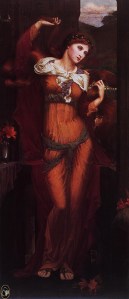
    The painting displayed is “Morgan Le Fay” by John Roddam Spencer Stanhope. This particular visual representation depicts a beautiful, seductive version of Morgan.