Moral licensing

I was watching a debate between Slavoj Žižek and Jordan Peterson where Peterson alluded to a common psychological pattern that can be observed in daily life, known as self-licensing or moral licensing. It’s the tendency that occurs when some people perform a couple of casual, sometimes shallow and effortless good deeds and subsequently allow themselves to justify morally questionable actions as they – sometimes subconsciously – believe they have earned the right to do so. This phenomenon is related to cognitive dissonance, the desire to maintain a positive self-image, and the concept of moral entitlement.

People may be more likely to engage in morally questionable behaviour when they have previously performed a good deed (e.g. donating to charity or volunteering). Moral licensing is also frequently used as an excuse to justify treating others poorly. Some people may feel that, because they have previously done something good, they now have the “right” to do something bad – even if it is undeserved and unjustified.

This type of behaviour can be observed in many different contexts, involving social or family dynamics. Sometimes, when a person has simply assumed a moral higher ground for whatever reason, real or imagined, and they’ve reinforced their self-concept as a good person, they paradoxically feel entitled to do something less considerate; thus their own feelings of morality become distorted and don’t make a lot of sense as their current behaviour contradicts their positive self-image and values, as reflected through past deeds.

Essentially, this happens when their positive self-image has led to a sense of toxic moral entitlement, where they believe they are beyond reproach and their behaviour is acceptable, even when it’s harmful. If you’re an external observer noticing this phenomenon at play within someone else, you might feel mistrust and ‘moral repulsion’ and, if you’re personally affected, righteous indignation. But we have to acknowledge that this behaviour is not always conscious. Some people may not be aware of the detrimental effect that moral licensing can have on them and on others, and may genuinely believe that their actions are justified even when they are inconsistent with behaving in an ethical manner.

The phenomenon can usually be attributed to cognitive dissonance, the uncomfortable psychological state of holding two contradictory ideas simultaneously or acting in ways that contradict one’s values. As a way of relieving the discomfort of cognitive dissonance and restoring their good self-image, people will justify the less respectable behaviour by putting themselves on a pedestal and wrongfully attributing negative qualities to the person being treated poorly, for instance, which helps them reduce the dissonance.

Moral licensing can lead to unconscious bias and discrimination. Some people who engage in behaviours perceived as moral, such as supporting a charitable cause or volunteering, may be more likely to engage in discriminatory behaviour towards members of stigmatised or marginalised groups. This is because they feel morally entitled to do so based on the good deeds they have previously done, and therefore may not consider their subsequent discriminatory behaviour and prejudiced judgments as being morally wrong. In many cases, these actions are carried out without the subject being aware of their own biases or prejudices. This occurrence is especially concerning given the negative consequences it can have on people who are on the receiving end of this type of discrimination.

Research has also revealed that moral licensing can occur in the context of diversity and inclusion initiatives. In these cases, a company or organisation that promotes diversity and inclusion may subsequently engage in discriminatory behaviour towards people from underrepresented groups, because they feel that their prior support of diversity and inclusion initiatives gives them a license to act in unjust ways without being questioned.

Moral licensing often leads to great long-term negative effects, as the phenomenon can create an endless cycle of self-justification and rationalisation, making it incrementally difficult for people to act morally in the long run. They will regularly attempt to excuse their bad behaviour, justifying it through past moral acts. This can be conducive to a gradual erosion of moral standards and values, as they may become increasingly desensitised to immoral behaviour. Over time, there will be an increased tendency towards unethical decisions and actions. Keeping an eye out for this kind of behaviour in our peers and taking a stand against it is important in order to ensure that everyone is being treated fairly and with respect.

Viscerally Tired

Tired of false assumptions, projections, and flawed worldviews — tired of patriarchy, misogyny, misrepresentations, malice, arrogance, duplicity, and needless snark. Tired of finding myself caught in vicious cycles. Tired of a world that sometimes drains me, so I naturally retreat within. Tired of judgmental attitudes. Tired of jealous people. Tired of manipulation. Tired of toxicity. Tired of obsessions about aging. Tired of pathologising our differences. Tired of neurotic tendencies. Tired of inauthentic friendships. Tired of feeling expected to feign constant enthusiasm — joy, passion, care, even empathy for those who seem wicked. Tired of the quiet seep of others’ insecurities and projections into my mind. Tired of being judged for embracing my disenchantment. Tired of double meanings. Tired of ignoring the imminent necessity for a chemical dependency. Tired of being perceived. Tired of being misperceived. Tired of caring about being misperceived to the point of extreme self-censorship. Tired of succumbing to the impulse of being authentic and regretting it. Tired of dissecting everything I say from dozens of shifting perspectives. Tired of noticing everyone’s blind spots. Tired of both encountering misanthropic attitudes and, at times, harbouring them myself. I know I’m not immune — I sometimes quietly slip into misanthropy, and I’m learning to accept that shadow side as part of who I am. Tired of thinking in rigid binaries. And no, this isn’t what a mental health breakdown looks like for me. When I sense myself beginning to spiral, I tend to freeze, finding it difficult to update my personal social media channels or engage much at all.

[This is an older blog post. Unfortunately, I don’t remember the date.]

Misunderstood, Unperturbed Self

When I find myself in situations where I’m allowed to be myself, I notice how my discourse changes in my writings. My inner life is allowed to breathe, and the landscape of my soul becomes more vivid and expansive. By virtue of this expansion, it becomes more alluring. Strangely, when I’m not concerned with anything besides myself and conveying my inner life unperturbed by others, this allure draws people in my proximity. I then tend to find myself at a crossroads. I have learned not to let anyone cross my borders without a meticulous and often undetectable process of selection. Because of that, I’m sometimes inclined to test people. Yet, I try to do so while keeping every interaction genuine. Although I am a perceiver (INTP), I can’t deny I judge their responses more harshly and quickly than I would ever wish to be judged. In my view, I employ the right system of reference in my judgment. However, I must admit, I hate being analysed, especially in day-to-day interactions; it irks me profoundly.

When I am given the space to be myself, I have no desire to prove anything—and I mean this in the most positive way, unrelated to lack of productivity, hence everything feels more genuine as the walls of the fortress retreat in the ground. There is still a surrounding portal, veil-like, between my world and everything else, seemingly transparent, but in actuality having a transformative function, of shaping perspective, both ways: Representations of the other gaze in, seeing what they wish; depending on how healed or emotionally aware they are, they might see everything warped by projections or get closer to my meaning. Likewise, I look out, seeing the world through my filter, penetrative or transformative, surface-shattering, depth-piercing, death-defying.

When I’m in an environment where it’s unclear whether it’s sustainable for my true self, I’m sometimes (not always) ready to show up as myself, even if it means being misunderstood and subsequently irritated. What feels best is being unperturbed by others’ interpretations. My problem is that I can always see the world from a multitude of perspectives, which is both a blessing and a curse. This requires me to make an effort to pick the perspective most aligned with my self-concept and established set of values and beliefs, and then stand by it, regardless of the other perspectives I can give voice to. Life is sometimes about what you choose to pay attention to.

There have been times in my life when I couldn’t write—not because my inspiration or creativity deserted me, but because they were suppressed, captive, muted, just as I felt suppressed, captive, muted. During these times, a false self replaced me, influenced by external projections, reacting to others’ impulses, stepping into a role that was as distant as possible from the traits embodied by the people I disliked around me. How do I explain this without sounding like I’m drowning in the fluctuations of being? Or without it sounding like I haven’t embraced my shadow self? Can I even claim that, with certainty, to myself?

Microaggressions

How do you deal with microaggressions? I tend to oscillate between two outlooks in this department: on the one hand, I like standing up for myself and not letting anyone cross or undermine me; on the other hand, I’m aware that sometimes maintaining your composure is a sign that you are in control of your emotions and it can also be indicative of your inner strength, so not necessarily a sign of meekness. BK Shivani, a motivational speaker and spiritual mentor, said in one of her lectures that when someone directs negative energy towards you, you have a choice: you can either absorb the energy and internalise it without saying anything, thinking this is aligned with the notion of being a good person. You can throw it back at them, hence reflecting the energy and trying to hurt the other person even more. Or you can transform the energy and the pain and radiate love and respect. The most important thing is to be kind to yourself in how you respond. There’s no single “correct” way to handle these moments — some responses may be wiser or more constructive, but none diminish your worth. Rather than framing it as a matter of “what would be a more dignified response?”, it helps to recognise that microaggressions often stem from the other person’s unresolved insecurities. You have the right to choose your response in a way that feels authentic and safe for you. Removing myself from the situation is often how I deal with it, if that is an option. Remember that those who initiate the microaggressions are often the ones lacking both dignity and a moral compass.

I have encountered microaggressions in both professional and personal contexts. They often seem rooted in underlying issues such as sexism, misogyny (including internalised misogyny in the case of other women), xenophobia, and mental health stigma, especially during times when I undergo a challenging phase or reveal anything that indicates my mental health isn’t at 100%. This can also lead to gaslighting, as some people might use this aspect as a trump card as a way to deflect responsibility. Over time, I’ve learned to be more cautious about sharing my vulnerabilities. While factors like their jealousy may also play a role, I’ve come to understand that such behaviours often reflect the other person’s own struggles and feelings of self-loathing and disempowerment. I must say, the majority of people I’ve met and interacted with are not like this. I remain grateful for the many supportive and genuine relationships I have cultivated. Most of the time, I’ve been fortunate to be selective in my interactions and friendships.

This behaviour manifested itself through rather revolting attitudes that appeared to be designed to provoke a reaction from me, especially during moments when it was transparent I was not feeling well. While I tend to respond with empathy when I notice someone is visibly unhappy, either by offering support or giving space, I have noticed that not everyone approaches these situations with the same understanding. I’ve experienced moments when I was ridiculed for expressing emotion, judged for my fluid accent, interrupted mid-sentence, or even had my ability to interpret situations and understand others’ motivations questioned — often accompanied by thinly veiled, undermining remarks.

I’ve always been viscerally disgusted by this behaviour, yet I didn’t tend to acknowledge it unless it was directly and unambiguously offensive, generally. Why? I suppose out of pride — i.e. not wanting to give satisfaction to anyone engaging in this type of behaviour, since that’s most likely what they were after: a reaction, thus ignoring them tends to work in my favour because it makes them escalate the behaviour to ludicrous levels, and in their desperate hunt for a reaction they end up turning themselves into absolute clowns in my eyes and hopefully in the eyes of any other decent person who witnesses this type of decline. I also strive to maintain my resilience without positioning myself as a victim, especially when the behaviour is subtle or covert. This approach helps me channel my energy into positive interactions and personal growth rather than being drawn into negative dynamics and allowing them to define my sense of self.

I have learnt to accept that some people simply feel threatened or overshadowed by others’ energy even when others are simply existing; it’s pretty sad to think they feel inclined to act in such ways out of nowhere. When they encounter someone who is creative, intelligent, attractive, talented, or someone who is overall special in some way, the terminally insecure go into attack mode. They often resort to passive-aggressiveness. We have to ignore the obvious or veiled malice of the pathologically jealous, and see them for what they truly are: pitiful; otherwise resentment builds, and you shouldn’t allow insecure people to drop their emotional baggage onto you via insults because one day you might find yourself carrying that extra weight, which could lead to your lashing out and being the one demonised for being too reactive, albeit rightfully so. But that’s what happens when you find yourself in a toxic environment. Dissimulation can only get you so far.

How do you respond when you are deliberately provoked? What are your reactions and thought processes when faced with such situations? (so when someone triggers you on purpose & with ill intent, not accidentally). For example, do you experience an instinctive fight, flight, or freeze response, and are you able to transition into a more balanced state that helps you regain emotional control? How long do these feelings usually last? Do echoes of such experiences linger in your mind for a long time afterwards? Additionally, do you feel comfortable discussing your emotional triggers with trusted friends or partners, and does sharing this information help you manage your responses more effectively?

Aesthetic Sensibility

The narrative of our relationship with space is shaped and re-shaped by our minds, and not always in predictable ways. Mesmerising and haunting, that is how I would describe the aesthetics of Brutalist architecture now, although it hasn’t always been this way. I’ve mentioned before how impactful the relationship between ontology and aesthetics is to me. The way I relate to new landscapes featuring cold concrete, imposing facades, and the towering silhouettes of brutalism often constitutes an uncanny experience. In England, it happened when I gazed at Liverpool Metropolitan Cathedral, when I first walked the path next to the Roger Stevens Building in Leeds, and when I stepped on the grounds of Barbican in London.

The cold rawness of the stark, monolithic, slightly dystopian aesthetic carries echoes of the past seeping into the future, haunting my perception of self and place. It helps if the spaces appear desolate, without disruptions. And the atmosphere of a new place feels slightly more otherworldly when the boundary between Brutalist architecture and nature is blurred. Even better if the structure is abandoned and derelict. Although the haunting quality is already inherent in the eerie architecture of Brutalism. Moreover, for me, since I lived in a brutalist-socialist block – a type of structure that was ubiquitous during childhood, when I encounter a different version of the aesthetic of brutalism, in a new environment, the familiar and the unfamiliar collide.

It’s an uncanny feeling of revisiting a liminal place, the archetypal presence of the homely that is rendered alien, a ghostly intersection of memory and materiality. Being haunted by a double, the self becomes partly ‘other’, being watched by a higher external force whilst existing ‘elsewhere’, until that sense diminishes as the self acclimates to the environment and everything else outside that space actually becomes temporarily otherworldly. Temporary identity and place are interlinked, so whenever I see a new architectural space with Brutalist exterior design, my past selves which visited other Brutalist spaces are having a gathering and collectively pondering how inhabiting such an architectural space both preserves and erodes the past.

Brutalist design…both intimate and vaguely distant, startling and infused with echoes of sci-fi narratives, comforting yet unsettling. Inspiring a homesickness for a place that never actually existed and will probably never materialise, a chimeric shadow world of inner phantoms, a world that borrows elements from the geography of my childhood as well as from tech-noir films. Such experiences have a destabilising effect – surreal, almost. With their ghostly, whispery grey walls, the buildings seem to be living, breathing things, rather than static. There is an undertone of fear and anxiety, mixed with rapture. As we know, the uncanny can also signify a longing for a return to a state of unity, which may be intertwined with a more sinister primal desire, a pull towards inorganic dissolution. Hunting the familiar image of tech-noir dystopia, both living and dead, can symbolise a repetition compulsion.

Whilst exploring and intimately absorbing a Brutalist space, I uncover lost poetry and sensory fragments of my inner world, feeling strangely at home even as I find myself in a place of liminality. When I exit a Brutalist Zone (particularly one that I’ve just seen for the first time), everything else feels temporarily alien, unreal (I say a new one because through repetition, the allure is demystified and diminished). It’s a state of mild spiritual dissociation that makes me feel like I can gain essential knowledge about myself, about consciousness and about the universe, whilst acquiring a sense of distance from myself.

Self-Portrait

The spiritual (‘spiritual’ in a secular sense) pride sometimes accompanying the feeling of being attuned to the universe and highly perceptive of shifts in energies, angst, desires, signs of discomfort, motivations, attractions, repulsions, projections, insecurities, prejudice, coping mechanisms, vibrations, the multidimensionality of the human experience, and so on when I walk into a room means that when I am – not by choice – in the disposition that I actually have to go through a break from the reality of existence, I find it hard to open up about my inner experiences even a long time afterwards. Granted, that’s also due to the nature of my experiences, the way they unfold, and the type of real-life material they tend to feed on and feed into. It’s that and the fact that, in my darkest yet lucid hours, my worldview tends to become more assertive, particularly when I feel my boundaries are being crossed, which is what is amplified (and internalised) to surreal levels when I’m thrown into the vortex of my ‘other’ self, which is not something I’d like to consciously/actively even indirectly nurture outside of that.

Whenever I’ve tried opening up, things have gone chaotically wrong both interpersonally – as once I add that layer it becomes nearly impossible to know others’ angles, and in my subsequent experience of the breaks, which have gone hopelessly meta and more labyrinthine. Things no longer flow naturally in my interactions. And I put a lot of pressure on myself to rewire my thinking patterns in ways that are beneficial to me, but unfortunately, this has come to mean detachment, which implies automatically being less likely to experience positive emotions as well. I have come to accept that only those with a very similar predisposition and psychological history and configuration in addition to moral compass would ever be able to connect with me in any significant way. Perhaps meeting them will give me a feeling of belonging that I’ve not found anywhere, in any context, in my entire life, if I’m totally honest. I mean among those around whom I’ve actually considered (and entertained the thought that) I might belong, as there are many that I’m happy and proud I could never even remotely relate to. I’ve always been pretty individualistic and self-oriented though.

When I welcomed the possibility of connection, I realised I’m too secular for the spiritual. Too dreamy for the materialistically-inclined. Too pragmatic for the ones who ignore everything worldly. Too realistic and down-to-earth for the self-help community. Too willing to work on myself to be among those with a tendency to neglect and deny all responsibility in a quest for self-preservation. Too pessimistic for the idealistic. Too idealistic for the pessimistic. Too neurotic for the stoic. Too self-contained for the openly and unapologetically neurotic. Too guarded for the emotionally transparent. Too transparency/authenticity-inclined for the ones who repress all ‘negative’ human emotion. This either makes me sound perfectly balanced or dispassionate and insipid. Either way, what I care about is – would I be happy to meet someone ‘like’ me (i.e. alike in significant ways)? Would I be ready? Scared? Threatened due to shadow self denial? Exhilarated? Relieved? Would I even truly see them, and myself in them? I welcome the opportunity to discover, for I usually only feel like I can be myself when I am by myself.

The Uncanny Website Revamp

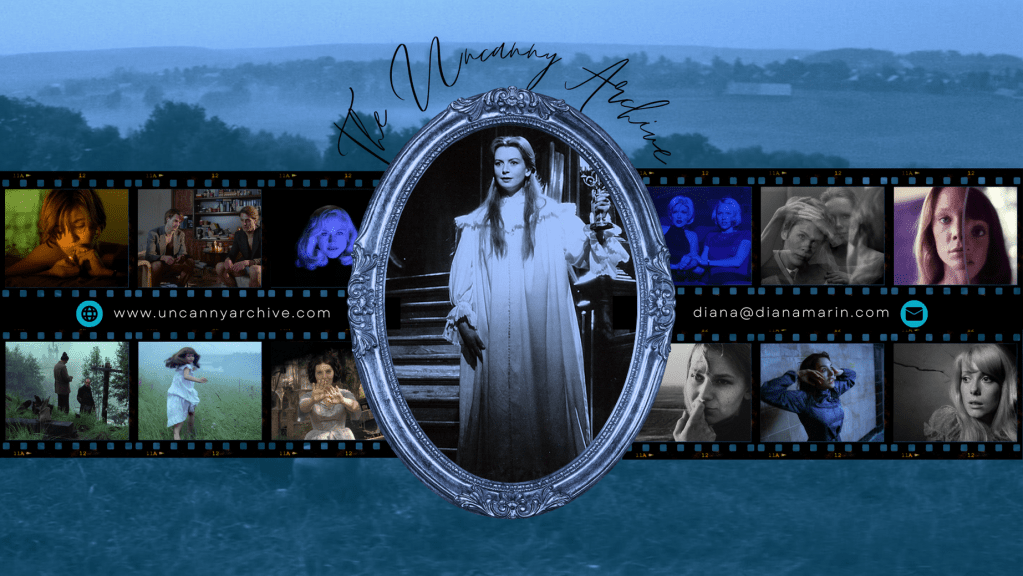
I just re-vamped the Uncanny Archive website, making it more atmospheric whilst including descriptions of different categories of the uncanny, as well as personal insights and additional information on the Freudian roots of the concept. There will be more web content coming up soon, so keep an eye out, especially if you’re a fellow lover of uncanny films and intriguing, moving narratives.

Within the first pages of his essay on Das Unheimliche, Freud adopts a humble tone, acknowledging that his analysis is limited by the lack of exposure to foreign literature due to conditions in the immediate post-World War I period. Within this historical context, the psychoanalyst’s interest and fascination with the uncanny arose from his experience treating post-war traumatic cases. This is evident in his essay, which consistently gravitates towards the subject of neurosis and the significance of repressed content of thought in the manifestation of the uncanny. 

Freud’s work itself turns out to possess some of the uncanny characteristics it describes. First of all, its purpose is to reveal something that is concealed within the parameters of subjectivity of feeling, of experience, and memories. […] Another aspect that Das Unheimliche shares with its subject and with many uncanny narratives is that it is haunting, repetitive, and filled with uncertainty. […] Certain works of art encompass that combination of factors through which the uncanny is born out of art and transcends into life, making the reader and the viewer experience it.

Visit the Uncanny Archive website to read more.

Self-love notes

Step into your wild self. Access your Dark Feminine energy to rediscover your full strength and unlock your untamed power. Recognise dark energies, but don’t fear them. Deconstruct the fortress of the self. Reweave the fabric of your world in innovative, transformative, driven ways. Embrace your Underworld i.e. shadow self, fears, desires; normalise negative emotions, seeing them as an opportunity to embrace authenticity. Allow yourself to experience nuanced emotions. Resist the temptation to bypass. Connect with yourself without neglecting the parts that you may have become disconnected from: reclaim them. Trust your instincts and assessments of the world, they’re usually accurate and you owe yourself self-belief. If it doesn’t feel right, it probably isn’t. Your intuition always sees through the fortresses of personas. Reframe your outlook on your whole existence. Embody the witch / alchemist archetype: Transform everything. Start by transforming your inner life, which will empower you to enact external change (including shifts in consciousness). Expand your vision, expand your knowledge. Only you have the power to hold yourself back from personal fulfilment. Some situations require control, others would be better navigated through an approach based on surrendering. You are the only one with the tools to discern between the two. Aim to be impervious to other people’s visions of your life’s trajectory. Avoid circumstances that don’t allow you to show up as your best, authentic self. Don’t feel a pressure to approach interpersonal relations as if they’re a performance and avoid situations where there is that expectation whenever possible. Healthy relationships don’t require you to change, pretend, cross your own boundaries, or feel depleted or uncomfortable in any way. Tap into childlike wonder and blissful maiden-like playfulness. Connect with nature more often. Be emotionally mature and empowered without losing a sense of connection with your innocence.

Uncanny encounter

Lifting the white veil, I open the old, mysterious drawer. Inside, next to a fairy tale-infused wooden music box and some forgotten Christmas and birthday cards that seem to either yearn for my full attention or yearn to be left alone or be destroyed, I see the charming box where the photographs are stored – those prosthetic memories that seem to have developed a life of their own. Where I currently live, few objects that are explicitly mnemonic tend to survive the memorabilia purge I execute regularly sometimes in my attempts at minimalism and sometimes for the sake of symbolically shedding the past and starting afresh – a peculiar habit, perhaps, for someone fascinated with archives and the archival process and antique stores. Any letter or card would have to be extremely emotional, soul-stirring, and potentially heart-wrenching for some reason (for instance reflecting the cavernously deep feelings of the sender) in order to coexist with me for long periods of time. I’d have to feel like throwing it away would be a blasphemous act. Or alternatively, there should be something within that object that propelled my mind to get spiritually irrational and make up a superstition about it, specifically a superstition of what might happen if I got rid of it, so I just let it rest in some corner instead, where it’s cast into oblivion.

Any physical diaries I have ever had have been burnt – I couldn’t get rid of them in any other way: flames are symbolic. The process is more cathartic than deleting a LiveJournal account, but everything has been digitised and that works for me, despite the supposed deprivation of the haptic pleasure and of the magic of writing with a fountain pen in a beguilingly beautiful notebook. With the amazing texture, designs, and cover art of some notebooks nowadays, I’d probably decay with indecision whilst trying to decide what thoughts were noble enough to be written in such a diary anyway, and if I managed to decide, I’d still curse myself whenever I have to cross out one word and I would embellish the hell out of those noble thoughts to the point where it would be more of an exercise in literary style, imagination, and language rather than one in authenticity, self-awareness, or memory preservation. I suppose I’ll stick to the occasional LiveJournal entries and notes on my phone for that.

I have also deleted many photographs along the years and there are long chapters in my life that only ever still exist, in some vague, distorted form, in my mind. Rather than doing so out of an impulse or lapse in judgement, it was always planned and I have always been at peace with it, which is even more sacrilegious. Freud would be disappointed – he praised the power of photography to act as a reliable mnemonic device, since physical proof of a memory combats the decay the memory would face if it were only stored in one’s mind – hence liable to distortions over time. In his view, diaries, photographs, cards, are all part of a chain of mnemonic devices which free us, helping us unload the burden that we would have to hold if memories were permanently retained in our minds. They are extensions of identity, of your inner life, aiding our capacity to remember, which in turn allows us to absorb new information and conceive fresh thoughts. Eh, anyway, family photos, in particular, lie by omission – in addition to being an enemy to individuality, which is sacrificed in favour of an unreal collective past. Belonging whilst losing one’s self. Not to mention the notion of counter-memory and how trying to retain the past might only bring about its destruction, ultimately alienating you from your past and from life and making you construct false or weirdly altered memories. Photographic self-obliteration as a form of resurrection or metamorphosis. The intersection between the other and the self, photographic depiction and identity: the end of existence.

I open the charming, memory-preserving or memory-annihilating box. The photo album has an imposing, magnetic presence. As I turn the pages, I remember most of the photos, so they’re hardly nostalgic artefacts. I’m quite desensitised due to this observation and the fact that nothing seems to elicit an emotional response. But then I reach one portrait that I must have seen before, surely, and yet there’s something I haven’t read on her face before. Am I imagining this? It seems uncanny. The girl in the picture, a defying, atemporal doppleganger, an embodiment of a spectral condition, seems to want to tell me “I refuse to exist as an afterthought in this simulacrum”. She wants to step out of the frame and haunt. “I want to smell like Alien, not naphthalene. And this curse of only seeing the light every few years during the holidays…” She reprimands me for forgetting her, for misunderstanding and misconstructing her, for only reanimating her as a “Screen Memory” on rare occasions. I want to hug her. Tell her she is more myself than I am, in a way. Tell her she wouldn’t like it out here. But I remain silent. My expectation of chasing decaying memory traces has turned into an uncanny Blow-Up moment as I catch a glimpse of resignation and almost grief on her face. As I notice this, the door to the unconscious is slightly open, but not enough for her to escape. I know I was supposed to integrate her. But she will be here until next time, feeling trapped. And I will still feel both protective and afraid of her. Perhaps next Christmas it will be different.
Thoughts

There has been a paradigm shift in the sense that in the past I was obsessed with our ephemeral nature and I used to drown in ruminations about mortality – not that I’m immune to that now, but I feel the focus is now on something else. Initially, this shifted towards the idea of rebirth and re-emerging from myself and leaving behind any psychological material, any thought patterns, any people, events, or memories that no longer serve me and that I need to shed in order to become a better version of me or step into a new, more enlightened self. The idea of identity is very limited – there’s this tension between being and establishing an identity because the latter is usually based on worldly things- accumulating things e.g whatever your idea of success is or knowledge. I’m reading an interesting book about the difference between knowledge and self-knowledge, which I will elaborate soon. You’ll still have this nostalgia for who you used to be, you’ll be haunted by the ghosts of past versions of you, with their own dreams. Unless you are able to shed all those layers and not repress but step out of that state towards a new you and embrace the now, embrace the current experience and let yourself be guided by the subtle currents of mindfulness and gravitate towards the reality of wholeness.

The difference between knowledge and self-knowledge is that objective knowledge is disembodied knowledge; it can be alienating and, paradoxically, it’s all about ‘me, me, me’, about how you can profit from something, how you can use information and map out the structure of reality in such a way that it allows you to manipulate the reality around you. And it’s focused on the wrong values like being in control (because it’s the realm of the ego), having a sense of power and control over others – which makes you feel good. At the opposite pole, you have self-knowledge, which is a world-centred view of the self: it’s all about felt experience and how you relate to the world around you, to nature, to people. Self-knowledge is used here in the sense of embodied knowledge and integrated information and it’s all about your body’s attunement to the world and about felt relationship and felt experience, when parts of you become illuminated. It’s not about thinking about the self in limiting, ego-driven ways, on the contrary, it’s about turning the focus towards the world and being in harmony with the world rather than trying to establish order and control. It’s not about control, it’s about surrender in a way, and about being present in the world and allowing yourself to integrate all aspects of the self as well. It’s something that reaches the depth of who you are by shedding all those layers that you were perhaps conditioned or wired to adopt. When you do that you are able to experience the wholeness of the world and the fluidity of being as well. And you will be able to resonate with the world around you and your entire world has the potential to change in a very beneficial way.

Self-integration should make you get rid of anxious self-conscious musings. By embracing all those aspects, you are able to become yourself. You can just witness emotions- this is a classical stoic teaching- you can witness an emotion – no need to numb it down- then distance yourself from it, allow it to pass, observe it, learn what you need from it, and then move on, with that knowledge in mind. As long as you are attuned, your body is attuned, your whole being is attuned to the diversity and the wholeness of the world, I believe that is the secret to happiness, inner peace, harmony, and comfort – being at ease with yourself. It’s not always easy; we do have a tendency to let certain things define us like a certain emotion especially if it’s a negative emotion, one that you’ve experienced too many times you feel like you might let it define you – especially if external factors like people around are also pointing that out, emphasising that or only choosing to see that. So you shouldn’t let yourself be defined or tainted by anyone’s perception of you, by your own focus on a particular negative reaction or emotion, because you are so much more than that.

Regarding success, even when you want to separate yourself from other people’s ideas of success you have to do it successfully so in a way that feels successful to you based on your own frame of reference or system of values which means you have to have a lot of faith in that in order for it to withstand the currents of opposing views. Spirituality tells us we are innately worthy, that worth should not be attached to external factors. I think for me success would be the idea of integration and harmony, especially inner peace. That looks a certain way, I have a vision of what it means. I don’t know where I’d be if I didn’t have the capacity to make things vanish. The capacity to move on, step into new selves is important to me.

This made me think of that line from The Tree of Life which I will always remember- amazing film- the dichotomy refers to what I was talking about before about the self-centred view of the world versus when you look outwards and try to establish a relationship and with the world around you based on harmony.
“The nuns taught us there are two ways through life, the way of Nature and the way of Grace. You have to choose which one you’ll follow. Grace doesn’t try to please itself. Accepts being slighted, forgotten, disliked. Accepts insults and injuries. Nature only wants to please itself. Get others to please it too. Likes to lord it over them. To have its own way. It finds reasons to be unhappy when all the world is shining around it. And love is smiling through all things.”

As beautiful and poetic as it sounds, I have always had mixed feelings about this quote. Accepts being slighted, forgotten, disliked? That’s not the way. But I can see what they mean: the way of Grace is about transcendence; it refers to not letting external things affect you, it doesn’t necessarily mean you stay there and endure hardship and mistreatment, it just means you are strong – it’s about real power and transcending and about how the other – the one who was metaphorically referred to as nature has a false sense of power gravitating around the concepts of control, entitlement, order, wanting to establish order rather than focusing on harmony. Seeing the darkness in everything, which is basically a reflection of what is within. Not that there’s no darkness around you, but if you only see that, that says something about what’s inside you. Grace, on the other hand, only accepts insults and injuries in the sense that those things don’t change grace; there is something immutable about grace that makes it so that she doesn’t change in the face of adversity to the core. Her system of values doesn’t change. Things that don’t matter can change. So in this sense I do agree with the way of grace, however I have my doubts about the way this is expressed. I do stand by stoicism and the stoic world view, I always have. These are not opposites: You can preach about the fluidity of the self whilst at the same time holding onto that immutable aspect of you. A balance between the way of grace and of nature would probably be ideal – taking the best characteristics out of each and synthesising them and there you have it. This is kind of like how self knowledge and knowledge have to go hand in hand to be balanced and the more one grows the other one has to grow with it. As you cultivate your objective knowledge, the one responsible for accumulating information to use it in certain ways, you should also work on and nurture your self-knowledge.

The two ways of seeing the world (self-centred & world-centred) are also reflected in Only Lovers Left Alive through the following encounter between the two protagonists. Tilda Swinton plays an insightful vampire, sharing her perspective with her perpetually despondent blood-drinking lover.
Eve: “How can you have lived for so long and still not get it? This self obsession is a waste of living. It could be spent on surviving things, appreciating nature, nurturing kindness and friendship, and… dancing.”