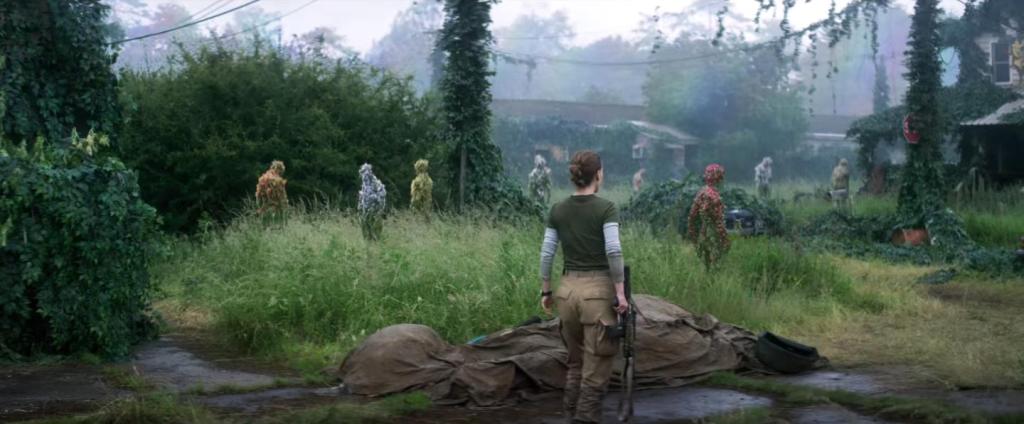
After the success of his intense directorial debut, Ex Machina, Alex Garland creates a cinematic adaptation of Jeff VanderMeer’s first book from the Southern Reach Trilogy, Annihilation. The sci-fi thriller turns out to be a visually stunning exploration into the unknown, which in this case borrows the form of the enigmatic ‘Shimmer’, a disquieting yet alluring foreign veil encompassing a part of the Earth, Area X – ceaselessly expanding and threatening to swallow the whole world.
The film opening reveals Lena, the protagonist, a biologist portrayed by the enigmatic, detached Natalie Portman who appears disoriented while being interrogated about the expedition and its survivors. The next scene introduces us for a brief moment to the desolate landscape surrounding the lighthouse, which is mysteriously related to the powerful alien presence the film revolves around. The lighthouse becomes a symbol, the connection with another world, with something uncanny, just like the Monolith from 2001: A Space Odyssey (1968).
The eerie and toxic beauty of the scenery from Area X echoes the dystopian “Zone” depicted in the well-known sci-fi, Stalker (1979), directed by Andrei Tarkovsky. Similarly, just as the Zone proves to be a philosophical journey, the Area X expedition also symbolises an exploration inwards, and eventually, a disintegration of identity – an idea poetically alluded to through the words uttered by the psychologist in a crucial intense scene towards the end: “Unfathomable mind: now beacon, now sea.”, quoting Samuel Beckett.
There are many alluring elements contributing to the immersive nature of the film and its fascinating uncanniness: The alien presence of an ambiguous nature, strange, nightmarish mutations, a symbiotic connection and the fear of being assimilated into something terrifying, blurred lines between self and other, the process of doubling, the tension, the eerie, magnetic atmosphere, gripping narrative, philosophical, introspective discourse, and compelling body horror imagery consisting in familiar elements depicted in a sinister, macabre way.
A geomorphologist, a paramedic, a physicist, a biologist, and a psychologist enter the Shimmer seeking answers and, whilst they encounter biological anomalies, beauty and decay, and a lot of unanswerable questions, we are encouraged to wonder what really lies beyond their (and our) human drive to enter the unknown, as well as how the uncanny encountered outwards echoes the uncanny within each of them.
Here are a few haunting excerpts from the eponymous book by Jeff VanderMeer. Among other thematic concerns, the book is also focused on environmental themes and metaphors for the conflict between nature and culture. VanderMeer alludes to the relationship between human beings and planet Earth, which can also be viewed through a lens of contamination. He emphasises the idea that nature should be treated as a part of us, just as we are part of nature; for if we dismiss it, we become alienated from a part of ourselves, of our humanness.
The following excerpts are amazingly reflective of the concept of the uncanny:
“The effect of this cannot be understood without being there. The beauty of it cannot be understood, either, and when you see beauty in desolation it changes something inside you. Desolation tries to colonise you.”
“I believed that it might be pulling these different impressions of itself from my mind and projecting them back at me, as a form of camouflage. To thwart the biologist in me, to frustrate the logic left in me.“
“A day that had the clarity of dream, of something strange yet familiar – familiar routine but strange calmness.”
“And what had manifested? What do I believe manifested? Think of it as a thorn, perhaps, a long, thick thorn so large it is buried deep in the side of the world. Injecting itself into the world. Emanating from this giant thorn is an endless, perhaps automatic, need to assimilate and to mimic. Assimilator and assimilated interact through the catalyst of a script of words, which powers the engine of transformation. Perhaps it is a creature living in perfect symbiosis with a host of other creatures. Perhaps it is “merely” a machine. But in either instance, if it has intelligence, that intelligence is far different from our own. It creates out of our ecosystem a new world, whose processes and aims are utterly alien—one that works through supreme acts of mirroring, and by remaining hidden in so many other ways, all without surrendering the foundations of its otherness as it becomes what it encounters.”
“[…] Imagine these expeditions, and then recognise that they all still exist in Area X in some form, even the ones that came back, especially the ones that came back: layered over one another, communicating in whatever way is left to them. Imagine that this communication sometimes lends a sense of the uncanny to the landscape because of the narcissism of our human gaze, but that it is just part of the natural world here. I may never know what triggered the creation of the doppelgangers, but it may not matter.”
“The strange quality of the light upon this habitat, the stillness of it all, the sense of waiting, brought me halfway to a kind of ecstasy.”
― Jeff VanderMeer, “Annihilation”

 DIANA MARIN