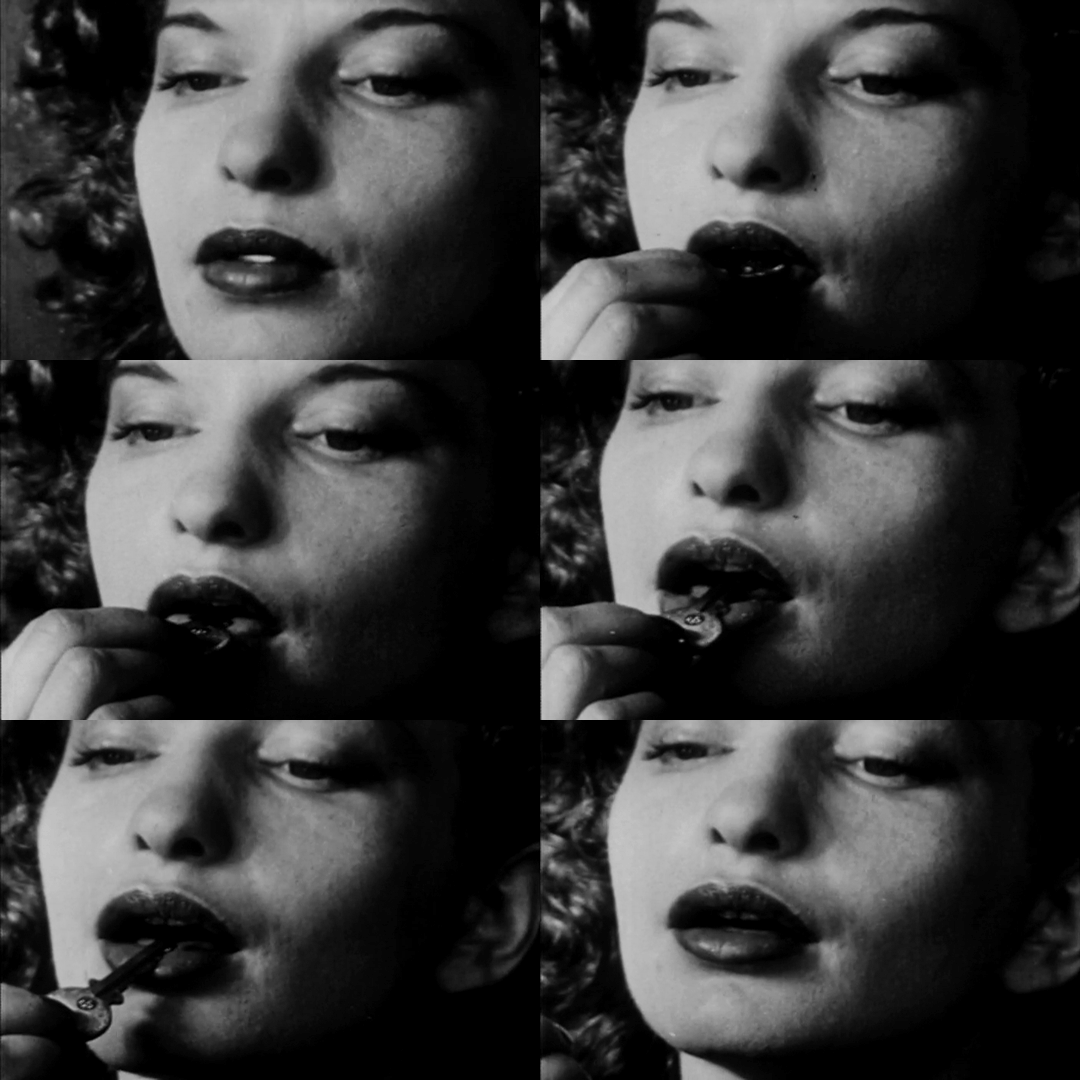
 Meshes of the Afternoon (1943) is a memorable, experimental, surreal short film directed and written by Maya Deren. Referred to as poetic psychodrama, the film was ahead of its time with its focus on depicting fragments of the unconscious mind, externalising disjointed mental processes, dreams, and potential drama through poetic cinematic re-enactments brought to life by uncanny doppelganger figures. The enigmatic protagonist, played by Deren herself, enters a dream world in which she finds herself returning to the same spots and actions in and around her house, chasing a strange mirror-faced figure in a nightmarish, entangling, spiralling narrative. Whilst she ritualistically goes through nearly identical motions, with some slight changes, within a domestic space that is imbued with dread and a sense of doom, unreality, and foreignness – we also witness glimpses of multiple versions of herself, watching herself. The camera shifts from subjective to objective angles as the self-representation of the protagonist alternates between the dichotomous concepts of the self and the “other”. The domestic space revolves around certain recurrent symbolic objects. The film conjures up the uncanniness of dissociation or, more specifically, depersonalisation; self-obsession, a woman’s dual inner/outer life and subjective experience of the world, all congruous with Deren’s interest in self-transformation, interior states, surpassing the confines of personality and self-construct, as well as the self-transcending rituals of Haitian Vodou. The dream story, culminating in death, symbolically alludes to the -sometimes strange and terrifying- initial, non-rational stage of the Jungian process of the “transcendent function” (the symbolic confrontation with the unconscious) leading to the separation of awareness from unconscious thought patterns and the liberating reconciliation between the two opposites: ego and the unconscious, which also has the effect of integrating neurotic dissociations.
Continuity is absent in the disjointed dream narrative of the film. The woman goes up the stairs inside the house and unpredictably emerges from the window in a haunting shot, wrapped in and caressed by soft, semi-transparent curtains. After catching her 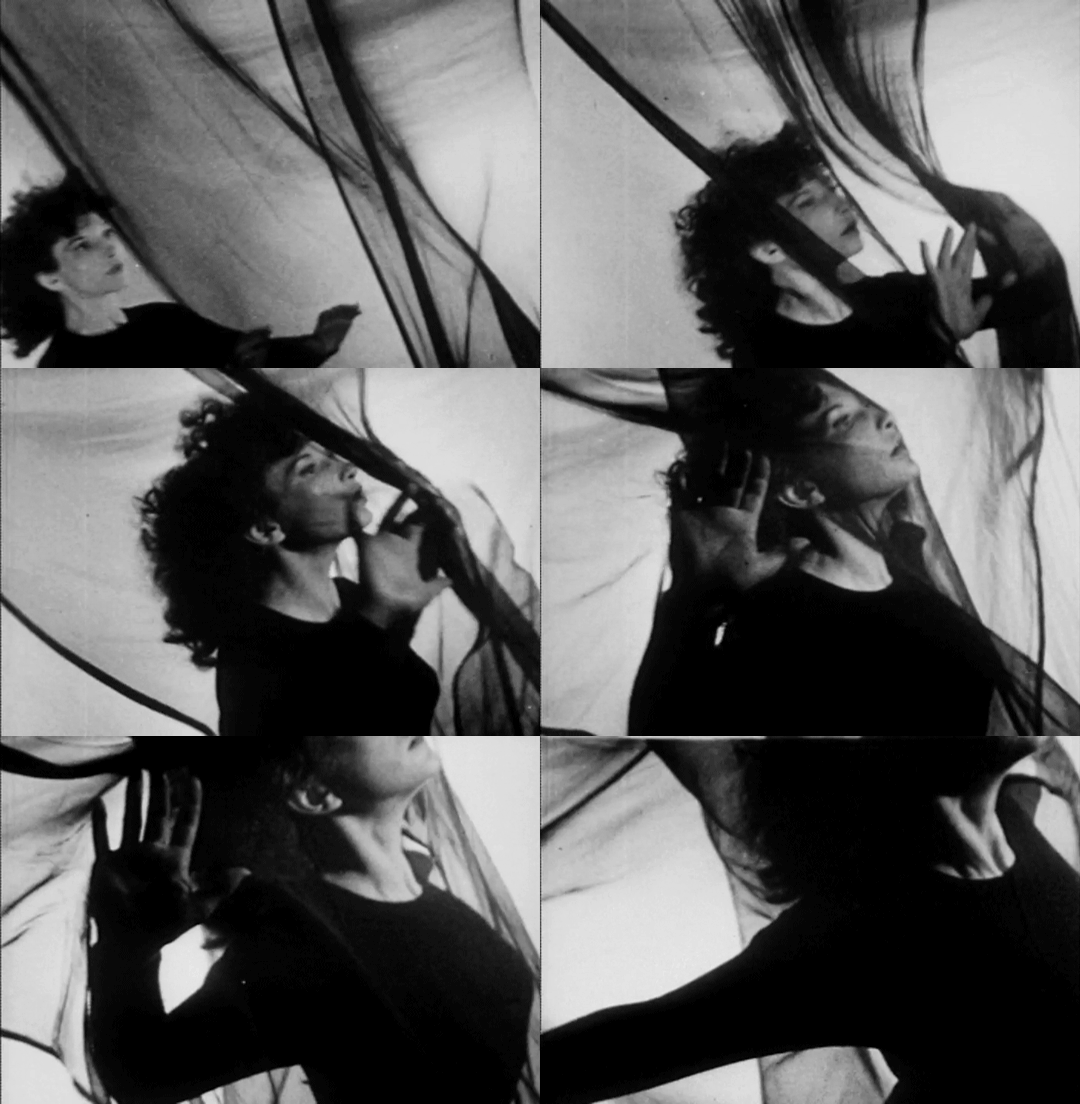 distorted reflection in the polished knife, the camera follows her fluid bending movements as she is crawling on the staircase, whilst being strangely blown away by the wind in various directions within a claustrophobic space, levitating, trying to hang onto things, and eventually hanging in a crucified position against the wall. With her bat-like presence casting a larger-than-life shadow behind her, she gazes at her sleeping body on the couch through a point-of-view shot from the ceiling. This moment vividly evokes the concept of an out-of-body experience. She then watches a previous version of herself through the window, following the flower-holding, black cloaked figure outside. Unable to catch up, she enters the house, and the subjective camera movement switches to this version of her, whilst she catches a glimpse of the funereally dark, cloaked apparition walking up the stairs.
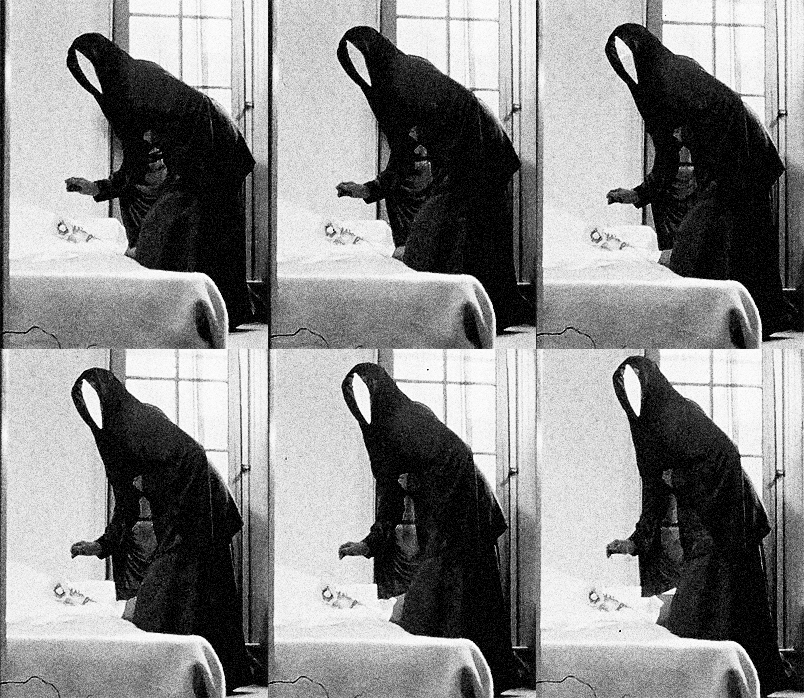 The elusive mirror-faced character is compelling and symbolically evocative. Nun, Grim Reaper, or mourner? The hooded black cloak and the ritual of bringing a flower to someone’s bed are immediately reminiscent of death, of mourning, and associations between bed/tomb and sleep/death. As the face of the obscure ghost-like manifestation is actually a mirror showing the reflection of the watcher, the scenario conjures up the idea of mourning one’s own death. After leaving the flower on the bed, the character disappears and the image of the woman also disappears and re-materialises several times, back and forth on the staircase. She then heads towards her own sleeping body whilst holding a knife, proceeding to try to stab herself before she awakens and sees a man holding a flower in front of her.
The phantom steps of the hooded dream character are traced and re-traced by the man and the woman in what appears to be reality but turns out to be a dream within a dream. The man carries the flower upstairs, leaving it on the bed, a gesture that echoes the dream act but is seen in a different context- of intimacy rather than a religious or funereal act. 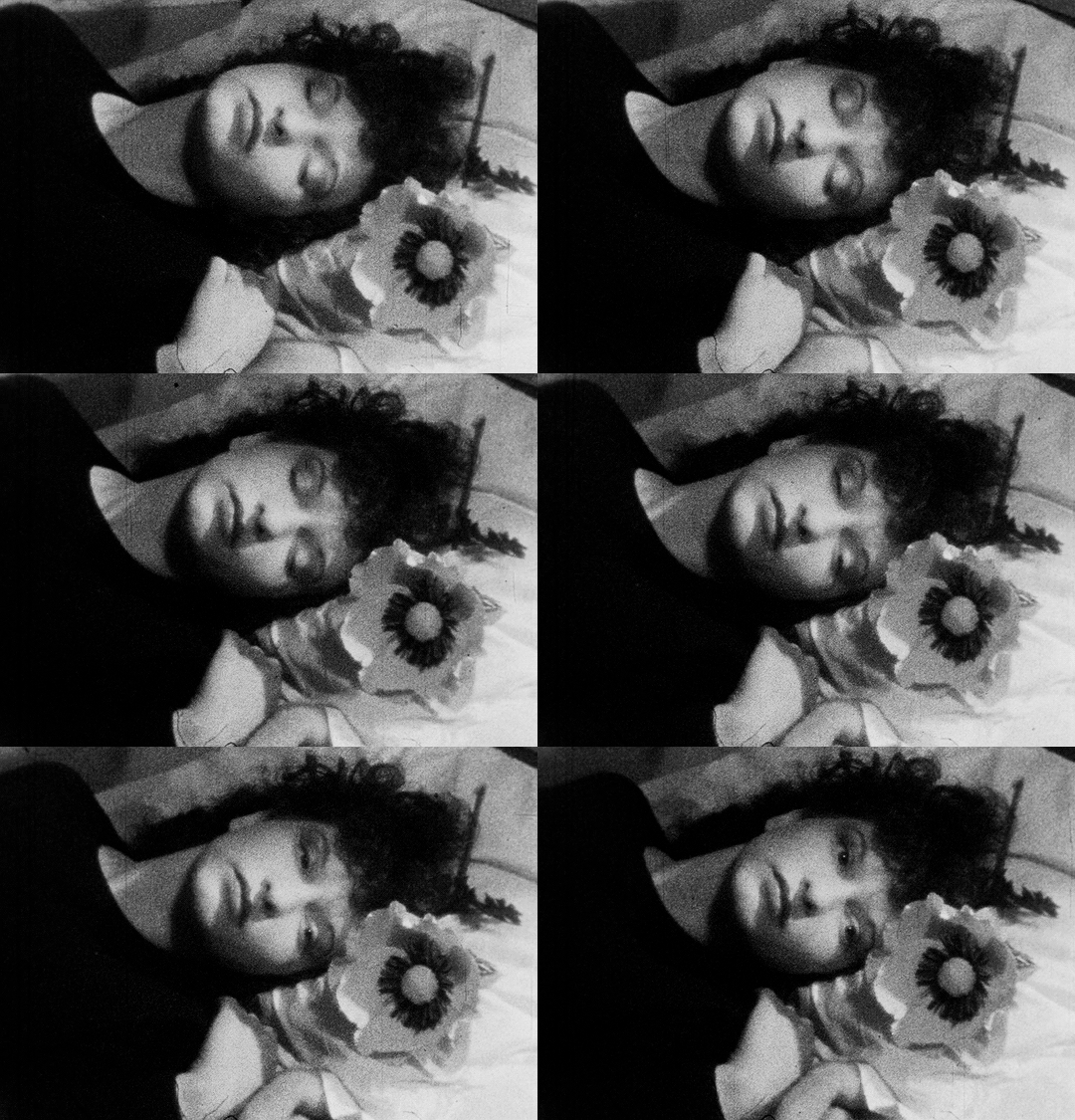 The flower, a symbol of femininity, is therefore connected with death and sexuality, respectively. After a shot of the reflection of the man in the mirror next to the bed, we watch her lying down through the male gaze. The camera switches to the predatory look on his face, and, as he is about to touch her, she grabs the knife and tries to stab his face. At this point, the knife breaks a mirror instead, and the face of the man disintegrates into shards (another connection between the man and the dream figure), revealing an image -perhaps a memory- of waves and the beach. The man comes inside the house again to find the dead body of the woman on the couch- she committed suicide by cutting herself with a mirror.
Deren poetically described the moment of the intertwining worlds as “a crack letting the light of another world gleam through.” [Deren, “A Letter”, in Essential Deren]
The uncanny dimension of the film lies in the transformation of the familiar environment into something mystifying, the dream-reality ambiguity, the repetition compulsion, the doubling (tripling and quadrupling), the distortions in spatial and temporal awareness, as well as the repetitive use of familiar images such as household objects that seemingly gain unknown symbolic connotations, whilst functioning as mnemonic devices. The juxtaposition of objects also contributes to the sense of dread and paranoia- the off-the-hook phone, the silent record player, the flower left behind by the enigmatic figure, the knife, the falling key. We can associate the off-the-hook phone with loss of communication, the knife -phallic form, therefore masculinity, besides the surface level connection with danger and death, the flower, as mentioned, having a contrasting effect-femininity, but also, death in this context; the key represents confinement, repression, and feeling entrapped, but also the possibility to escape. When the woman pulls out the key from her mouth, perhaps she had “the key” to find the way out all along, and then, as the regurgitated key turns into a knife, there is a connection between escape and (psychic) suicide. The mirror stands for introspection, and the death by mirror cut might allegorically refer to the disintegration of the identity construct, linked to liberation. When a version of the woman picks up the knife, she is re-claiming her agency, wielding phallic power.
It is worth mentioning that the director strongly opposed and discouraged psychoanalytic interpretations of her film and of the symbolic significance of the objects the film revolves around, instead encouraging the viewer to only interpret them in the context of the film narrative as a whole to avoid going beyond conscious intent in art. This brings me back to an inner debate on the topic of film analysis, its limitations and the question whether there is such a thing as going “too deep” into conscious and unconscious meaning behind film. The “risk” of going too deep is ingrained in the nature of the work of any film scholar or critic, especially when it comes to cine-psychoanalysis. However, when it comes to surreal films in particular, the intentions are blurred and open to interpretation, and clearly Deren’s art is lyrical in its symbolic nature, created by association of poetic images, and influenced by her interest in psychology. Before turning to cinematography, Maya Deren expressed herself through poetry, but she found it too limiting to convey the images in her mind through words.
To respect the wishes of the creator, let’s also look at her own statements related to the film, as well as her general preoccupations and beliefs, which are transparently relevant to the film.
“This film is concerned with the interior experiences of an individual. It does not record an event which could be witnessed by other persons. Rather, it reproduces the way in which the subconscious of an individual will develop, interpret and elaborate an apparently simple and casual incident into a critical emotional experience.” —Maya Deren on Meshes of the Afternoon, from DVD release Maya Deren: Experimental Films 1943–58.
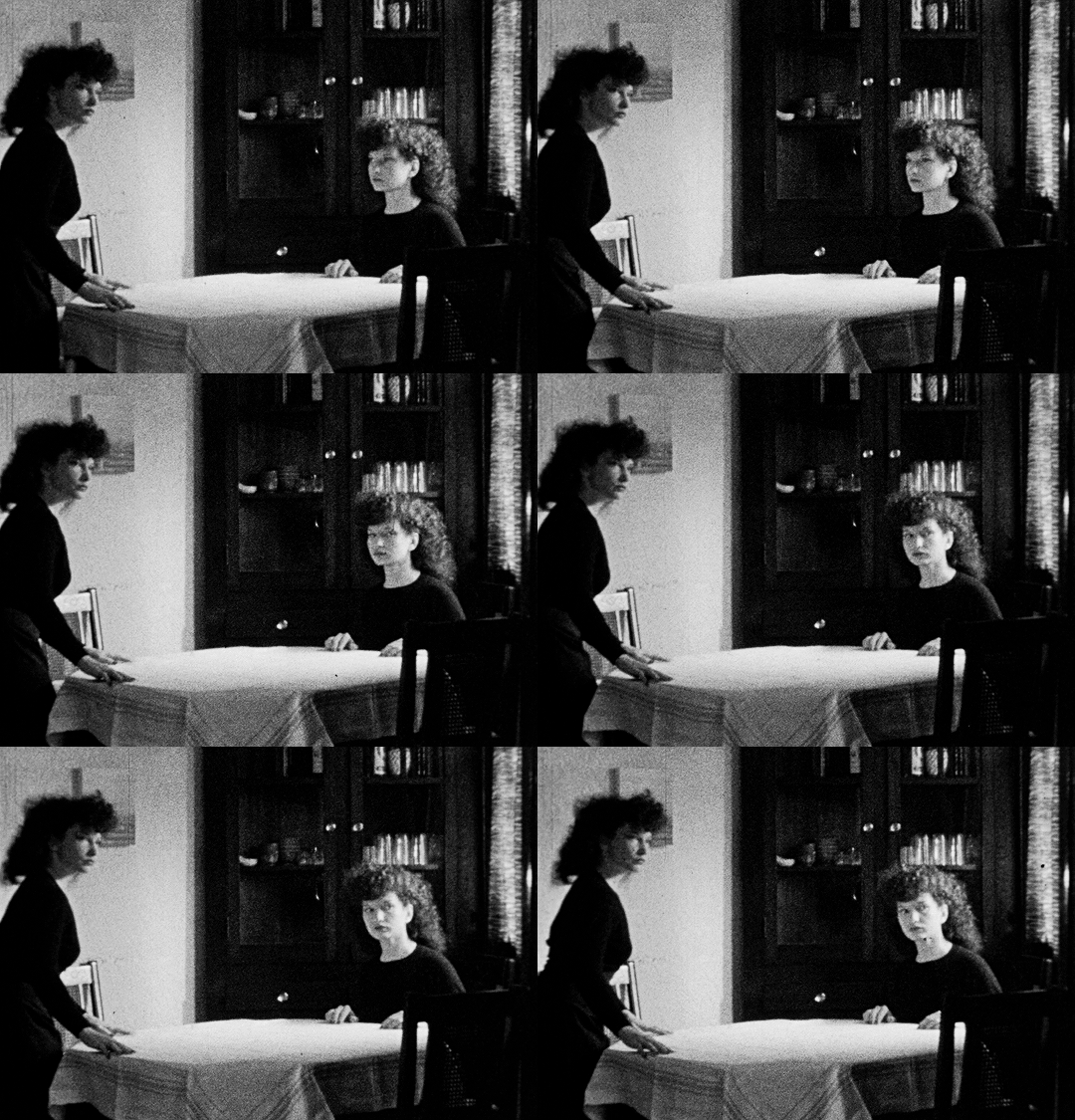 The multiplying of the character is connected to dissociation, alienation, emotional fragmentation, and potentially reintegration towards the end. The multiple incarnations of the woman evoke an internal schizoid narrative breathing life into alternative versions of herself- challenging her self-construct. Some of her personas are passively observing her more powerful, key-holding, knife-wielding persona. The suicide is symbolic, despite the fact that, in the final scene, it appears as if the layers of the dream world are peeled off and we have access to the real world. I believe the death symbolism is derived from Jungian psychology- i.e. the death and resurrection of consciousness. In light of this thought, the film can represent a visual representation of Jung’s Transcendent Function. What unfolds on screen is the process through which a person gains awareness of and confronts unconscious material driving their life in order to unite and re-channel the opposing energies of the ego and the unconscious into a third state of being, of wholeness. This would also have an integral effect that will merge the embodiments of the character’s dissociations. According to Jung, the process involves a challenging, unnerving unleashing of fantasies, dreams, and instincts. The sense of dread and panic evoked by the film matches this idea. The process is also associated with the notion of ego death in Eastern philosophies.
To further delve into Deren’s psyche and establish other links, let’s remember that she was fascinated by the rituals of Haitian Vodou and religious possession. She later participated in Vodou ceremonies and documented the rituals. Together with her love of dance (and later, her experience with recreational drugs) her immersion in and fascination with rituals were also a result of seeking to drift away from self-centredness, to go beyond self-construct and personality, and merge with something greater. This is again related to the Buddhist concept of ego death – a transcendent, life-turning mental state with self-revelatory consequences. We know that Deren has a preoccupation with the transformation of the self and reaching higher spiritual states of awareness. In this excerpt from An Anagram of Ideas on Art, Form, and Film (1946), she makes insightful comments about ritual:
“The ritualistic form treats the human being not as the source of the dramatic action, but as a somewhat depersonalised element in a dramatic whole. The intent of such depersonalisation is not the destruction of the individual; on the contrary, it enlarges him beyond the personal dimension and frees him from the specialisations and confines of personality. He becomes part of a dynamic whole which, like all such creative relationships, in turn, endow its parts with a measure of its larger meaning.”
I am glad she mentions depersonalisation and associates it with a form of spiritual awakening, as this coincides with my beliefs on depersonalisation and derealisation, which are also relevant to the film. The two often go hand in hand. Both experiences (note I’m not referring to them as ‘disorders’) involve a feeling of detachment – from one’s thoughts and from reality, as well as an awareness of this detachment (which distinguishes it from psychosis: there are no delusions or psychotic elements involved). Derealisation involves experiencing the world as if you are living in a dream or a film, and depersonalisation is the feeling of unreality of the self, which has been introduced as a psychiatric disorder of the dissociative type in 1930 and has been updated and re-interpreted several times in various psychiatric diagnosis manuals. Other common features mentioned in the DSM-IV are an uncanny distortion in visual and temporal perception, a feeling that other people, places, or events appear unfamiliar, unreal, or mechanical and lacking emotional depth. An individual experiencing this might feel like an outside observer of his or her own mental processes. All of this also applies to Meshes of the Afternoon where the protagonist is in a perpetual, adrift state of trance as she navigates the dream web and observes herself from an external perspective, whilst familiar objects appear foreign, strange, or ‘tainted’.
Here is an excerpt from Feeling Unreal, one of the few books tackling the elusive topic of DPD- written by Daphne Simeon, MD and Jeffrey Abugel. The description matches the insight and feeling revealed by Deren regarding the state of depersonalisation in ritual:
“No longer grounded by familiar sensations or surroundings, they feel as if they’re losing their grip on reality. But unlike people with psychotic conditions like schizophrenia, they are not going insane at all. They are, if anything, suddenly overly aware of reality and existence and of the ways in which their own experience is a distortion of a ‘normal’ sense of a real self. Depersonalisation, in fact, resembles a sort of altered ‘awareness’ or ‘awakening’ that in some cultures is thought to be a level of spiritual growth.”
It is worth watching both existing versions of the film: Your viewing experience might change depending on whether you watch the early silent version or the 1959 version accompanied by the official sombre, atmospheric soundtrack created by Teiji Ito, Maya’s second husband. You will also not be surprised to find out that the dreamlike atmosphere and narrative of Meshes was a source of inspiration for David Lynch’s Lost Highway (1997) and Mulholland Drive (2001).
 DIANA MARIN