Antique mirror
Dreamy fragrance
Heart-shaped silver locket with photo
Crystal figurine
Art phone case
Gothic candelabrum
Vintage bag
Sophisticated drop earrings
Lace garter
Confessional letters
Mubi subscription
Gaia subscription
Adventure games on Steam
White lace dress
Satin pillow cases and bed sheets
Embellished cosmetics
Vintage diary decorated with pressed flowers
Poetry books
Old film camera
Art bookmark
Musical box
Personalised Star Map
Antique Fountain Pen
Scented candles
Pressed flower jewellery
Press on nails with intricate designs
Deep conversations
Emotional support
Category: updates
-
Gift Ideas for a Sentimental Soul
-
Introspection
How is life? A work in progress. Just like me. I’m constantly growing and learning; acquiring knowledge of what fascinates me is one of my enduring obsessions. There is definitely more that’s unchanging and relentless about me (including, paradoxically, my regenerative strength), but it’s much easier and more palpable to articulate the ways in which I feel I have changed or the areas in which I invite change. In my life I have shifted from cynicism to idealism to optimistic nihilism to a sort of hedonism to aestheticism (I know I’m merging philosophical and artistic concepts here, but I think of them more widely, as approaches to life), and there have been times when I have ricocheted among them. I’ve spent some time in what may be considered an adrift state, but this has often led to acquiring better knowledge of what I see myself doing, what I enjoy and what I’m good at, a realignment with my deep wishes and interests, and attunement with myself, in all my glory and imperfection. On that note, add an increasing willpower to either embrace or change and improve imperfections, case by case, because that approach makes sense the most, a balance between personal development and contentment is key, and both complaining and self-pity are the most useless ways to spend your energy. Unless you write it down on a blog or capitalise on it or use it as fuel to express yourself through other creative outlets, in which case you can be relatable, earn something, or it can be cathartic. With that being said, perfectionism should be kept within limits, otherwise it becomes a sad quest.
After emerging with more self-knowledge regarding what fulfils me, plans have crystallised, but I need to maintain a healthy self-discipline in areas that are essential to my functioning and leading to a more substantial well-being rather than dopamine rewards. Building self-discipline is a challenge for most, and I’m the type of person who has always been most driven by spontaneous bursts of energy and motivation and outpourings of inspiration more than consistency and routine. I’m naturally inclined towards having a whimsical rather than methodical approach to life, with a lifestyle that may seem chaotic to some, though I can adapt and push myself to add order to chaos. I plan daily routines, but I sometimes end up doing what feels best ultimately, if I can afford to. This has worked for me creatively, in the past, but it’s not a viable or sustainable option as I age and have more responsibilities. I believe personality is a fluid thing, and thus I can adapt to something different and more efficient, but it takes a lot of deliberate effort to change something that has become ingrained in your being. I’m on the right track, though, because I’m getting into the habit of being more productive even when I’m not feeling at my 100 percent.
I want to put myself in the way of beauty and in the way of inspiration and of good things happening, even when my willpower is somewhat tentative- as opposed to resorting to taking the easy way out, or prioritising self-indulgence in the form of distractions, of whatever nature, and yielding to unproductive mental traps that get me stuck, creatively or otherwise. “Everything in moderation, including moderation” as Wilde said. Also, although focusing on materialising plans is necessary, it should be noted that this will definitely not be achieved by obsessing and thinking about the future, but by living in the now and taking steps towards tangible results- even small steps make a contribution. You’d think this should be obvious, but my brain often begs to differ for some reason. Obsessing over things and slipping into problems with self-discipline used to be my Achilles’ heel, but it’s something that I’ve focused on altering and dedication truly helps you forge new neural pathways. On another note, doing good deeds has a very uplifting power and effect for me. So does inspiring someone, either through my words or activity. I used to receive personal, touching messages online, in which people mentioned how I posted, wrote, or quoted the right things at the right times for them to see or read and how they’ve been inspired or helped by posts and that makes me smile. I like influencing and inspiring people, and this realisation has made me reconsider the appeal of certain paths to me.
I should probably nurture my dual & complicated relationship with vulnerability. I know better than to associate vulnerability with weakness, I know it can be empowering and unifying and brave, and yet, I find it so unnatural to open up entirely, I always have, partly because I don’t want to put myself in the position of allowing others to have full access to everything I am, partly because I don’t know how to convey things in an ideal way that makes me feel satisfied because I haven’t figured everything out but also partly because I’m at a point where I need to prioritise other things and don’t feel like I need to make many connections in order to be content. I’m also someone who doesn’t need constant contact to validate a friendship and actually in my book giving each other space and allowing yourselves to fall back into place and reach out to each other whenever you both need or feel propelled to is a love language. Also, it’s quite rare for me to fully resonate with another person so whenever it happens, when everything just flows and feels right I often feel this compulsion to protect it, and worry that there will come a moment when I might say or do something that alienates them, which triggers an uncharacteristic fear of abandonment. There are psychological shadows that I still need to integrate. I think it’s not uncommon, I think a lot of people curate their thoughts and feelings to express mostly positive or flattering ones, especially online. Within the context of a relationship, ironically, not wanting to give all of you can be considered a fear in itself, of sacrificing, of being tamed, subdued, sucked into, or simply, too dependent or entangled with someone else. Actually, I used to be quite the opposite in the sense that I felt like sharing many thoughts with others, I poured my mind and heart out. I still kind of do that, yet, on another level, perhaps emotionally, I’ve never fully given myself, in a way. At least I never feel like I do or that it’s beneficial. It’s also partly because we are all made of multitudes. Even though, in theory, I acknowledge that when you connect and give love (platonic, romantic, or of whatever nature), in a way, there is strength in putting yourself on that path, no matter what happens. But what happens if you become so enmeshed that you forget where you stop and the other begins? What happens when someone doesn’t act the way you expect him or her to? What happens when someone changes?
What else am I still in the process of learning? Learning to let go. Of detrimental or fruitless thought patterns, of the burden of roles other people may cast me in through assumptions or expectations because sometimes I’m not easy to read and other times I’m pretty straightforward and transparent, letting go of my own expectations from everyone in favour of focusing on whomever resonates with me and I resonate with, of unnecessary prohibitions and restraints uttered by a part of my psyche that I keep silencing, instead of reconciling with or making sense of in order to change it.
-
The Uncanny & London Exhibitions January – March 2020
Introduction: Reflections on the Uncanny
“The uncanny” is a bemusing, unsettling, strangely familiar phenomenon characterised by a feeling of disruptive eeriness and unreality piercing through the fabric of the mundane; it generates a particular type of response in one’s psyche and evokes an ineffable feeling. The uncanny generally teeters on the blurred lines between reality and illusion, self and other, life and death, the natural and the unnatural. It is a subjective experience, to which some people are more susceptible than others; and ultimately, it’s an elusive feeling, which varies from person to person, both in the source that stimulates it and in the particularities of the response it elicits. There is a notable distinction to be made between the cultural view of the uncanny – as represented through pieces of art, film, or other media, and the psychoanalytic one, as introduced by Freud in his influential essay on aesthetics, Das Unheimliche.
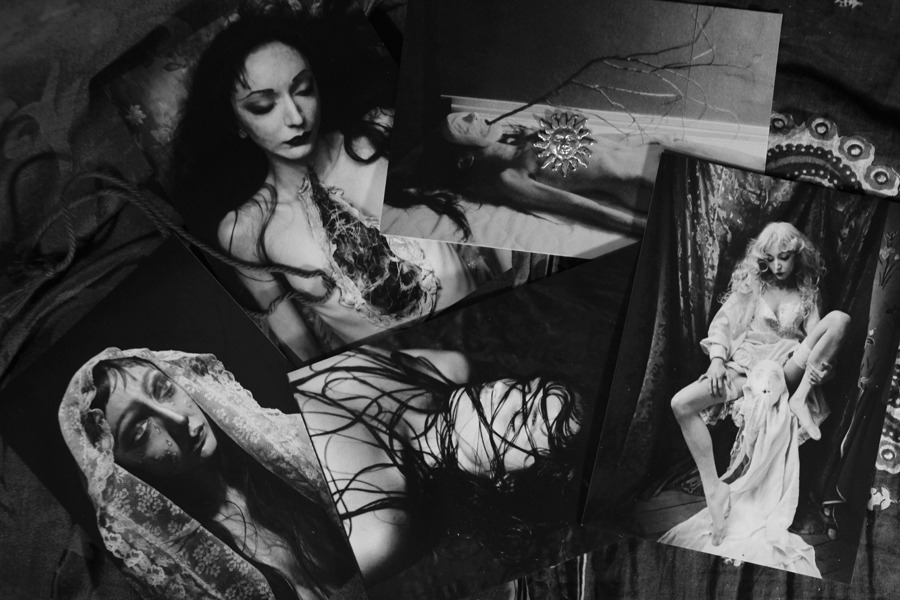
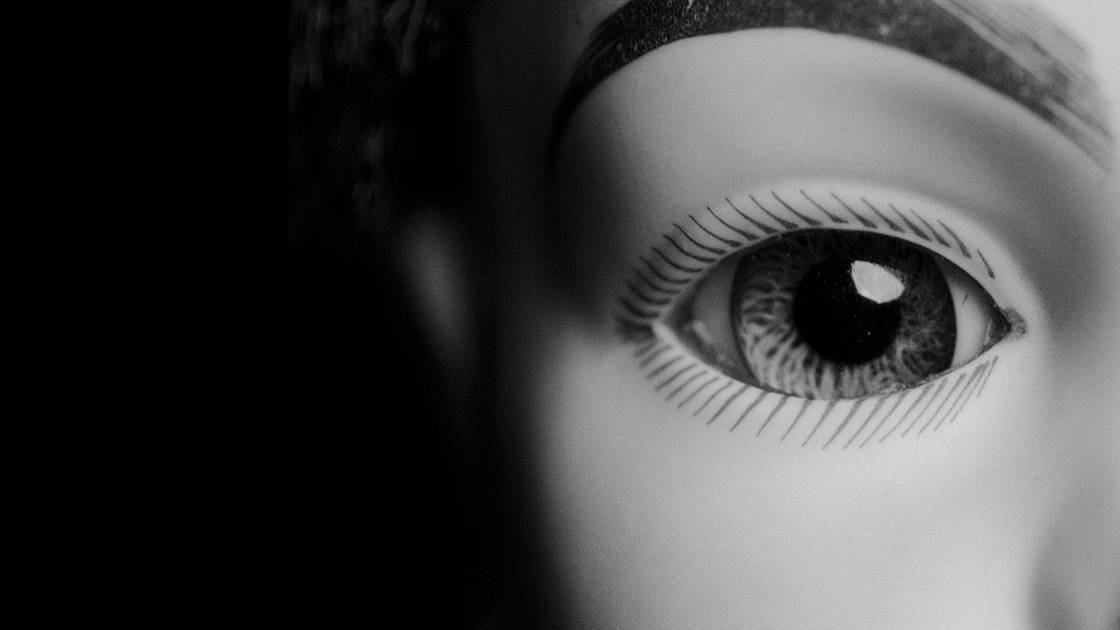
Art by Feebrile In fiction, the uncanny has often been associated with recurrent themes such as the double/doppelgänger figure, reflections, mirroring, strangely familiar apparitions, haunted homes, horror, & the symbolic return of the repressed in the form of ghosts, monsters, or other Gothic figures. In art, objects such as wax masks, automata, and lifelike dolls tend to be described as uncanny. This refers to what is known as the Uncanny Valley, emphasising the unsettling, repulsive effect of things of an ambiguous lifelike nature, objects that appear to be human and alive, but upon closer examination reveal themselves to be flawed human replicas. However, in psychoanalytic terms used to describe real-life phenomena, the uncanny diverges from the cultural perspective.
“[…]According to theological principles, these seemingly natural, living, moving figures are spectral, mere images, uncanny because illusory. Such images or effigies consequently appear to supplant reality or take over from it when no prior referent remains in existence (the Seven Deadly Sins are allegories, Helen is long gone). The uncanny is an effect of reflection without referent, or of creation ex nihilo. In other words, it rises from a false impression that soul, in all its imprecision and mystery, is breathing into something; but these intimations of soul presence begin to stir only to be withheld. Living likenesses strive to guarantee and perpetuate presence, but ultimately underline the vanished and absent subject; creepily, they resemble someone or something who is not there, as in a mirror reflection with no subject.” -Marina Warner, Phantasmagoria: Spirit Visions, Metaphors, and Media into the Twenty-first Century
Psychoanalytic discourse emphasises the subjectivity of the phenomenon, shifting the focus from the objects themselves (which are not inherently endowed with uncanniness) to how we, the observers, experience certain objects, settings, situations, and, as I would suggest, also art shows and artworks, in a way that perceptually challenges or disrupts our sense of reality, making us aware of the unfamiliar present in the familiar, and resurrecting phantom elements or modes of perception from our past, particularly from early childhood. Within these intimate moments, our being has an inner dialogue whilst a haunting sense of unreality temporarily permeates the fibres of our existence. In this light, the uncanny encompasses experiences such as a human subject unconsciously or seemingly accidentally returning to the same spot several times (as if compelled or pushed by an external force), the feeling of deja-vu, a peculiar sense of being watched, potentially by something supernatural, finding objects that you thought were lost forever, or stepping into an empty place that is normally filled with people. When it comes to the aesthetic experience, Derrida’s concept of hauntology applied to art (the extended definition of art) refers to how hauntological aesthetics can induce an otherworldly nostalgia by invoking phantoms of the past that are neither present nor absent, as well as a sense of a lost future.


In one of his inspiring talks held at the Freud Museum, British psychoanalyst Darian Leader linked the uncanny response with elements of anxiety, fear, and shock. Meanwhile, I have previously experienced the uncanny as a dream state, a combination of weightlessness, derealisation, lightheadedness, a sense of a distant, diffuse past merging with the present, of time being suspended or dissipated, of another world permeating current reality. I would describe it as a spiritual occurrence which can be resurrected by a scent, a melody, a film, an atmosphere, or an object, making me see the world through another lens, belonging to a much younger version of myself, who used to process the world in a more mystical way. This impression, this world pouring through another world, this repetition of a way of seeing is ambiguous, as it’s filtered through memories, which can morph as time goes by and “re-shape” the past. Such memories can summon echoes of seemingly insignificant, disjointed aspects and sensory moments that our minds may have considered fascinating. They are often distorted, or disguised. Unlocking the meaning behind a childhood memory is like drawing the latent image from the manifest dream. The uncanny response is sensory, emotional, and intellectual at the same time. Darian Leader also mentioned how a change in the subject’s self-image can appear in such moments, a self-perception as an object of the gaze of a higher external force, a perception of the self as ‘the other’, a fleeting sense of alienation from one’s own constructed identity, desires, sense of the world, or from reality. Darian Leader also emphasised the dimension of conscious or unconscious desire that is relevant in this context, and how the cancellation of the gap of that desire, so the moment of its fulfilment (i.e. the desire to find something or to recreate an old narrative or scenario) stimulates an uncanny response.
Freud’s essay starts with an in-depth analysis of the ambiguous meanings behind ‘heimlich’ and ‘unheimlich’, exemplifying the multiple uses of the German words, and how they are not always antonyms. Link to Freud’s essay on the uncanny: Das Unheimliche.
London Exhibitions – Last chance to see:
The Uncanny: A Centenary
Through The Uncanny exhibition, The Freud Museum celebrates 100 years since Freud defined and explored the concept of the uncanny in his well-known, pioneering essay on aesthetics entitled “Das Unhemliche”. The Uncanny programme held at the Freud Museum has included inspiring talks by Freudian psychoanalysts, artists, and academics on the topics of the uncanny in art, the uncanny in film, and the uncanny as a real life experience.
Immerse yourself in the evocative artworks exhibition and the haunting installation inspired by T. A. Hoffmann’s The Sandman at the Freud Museum. The exhibition features etchings by German surrealist artist, Hans Bellmer, as well as disturbing recent works by Elizabeth Dearnley, Lili Spain, Martha Todd and Karolina Urbaniak & Martin Bladh. Moreover, you can see Freud’s death couch, as well as trying the Sandman App, through which you can have an unsettling audio tour of the museum, with the Sandman installation as the memorable epilogue.
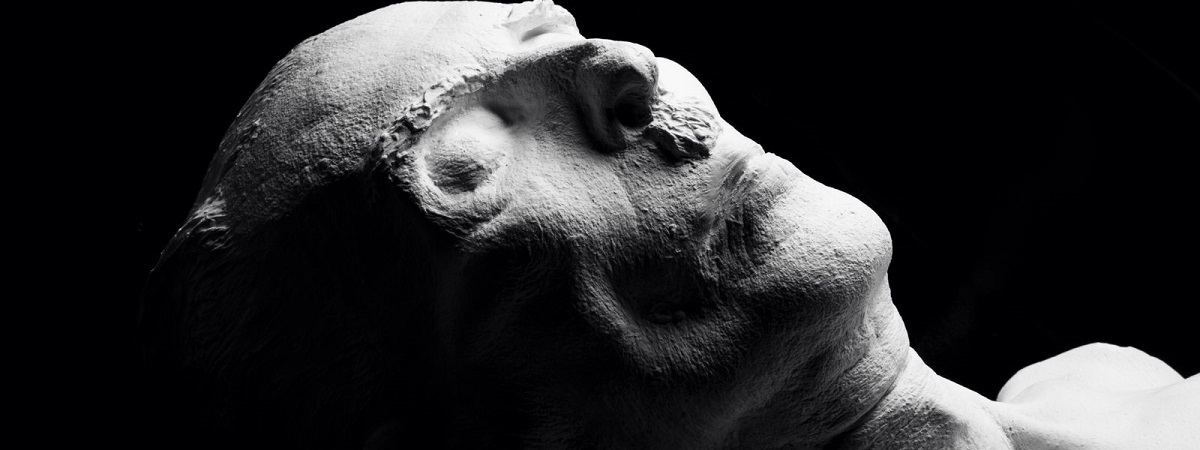
Besides the immersive exhibition, which is open for two more weeks, you can also attend two upcoming uncanny events, which can be found on the official website. One of the events is focused on Freud’s essay and links between psychoanalysis and literature, led by literature teacher Forbes Morlock, and the other, “Funerary Masks and Death Masks” is a talk by Nick Reynolds, British sculptor and creator of death masks.
Exhibition at Freud Museum until 9 February 2020.
Dora Maar


Surrealist photographs by Dora Maar, influential, nonconformist French photographic artist and one of the few female artists from within the famous group of the 1920s-1930s surrealists.
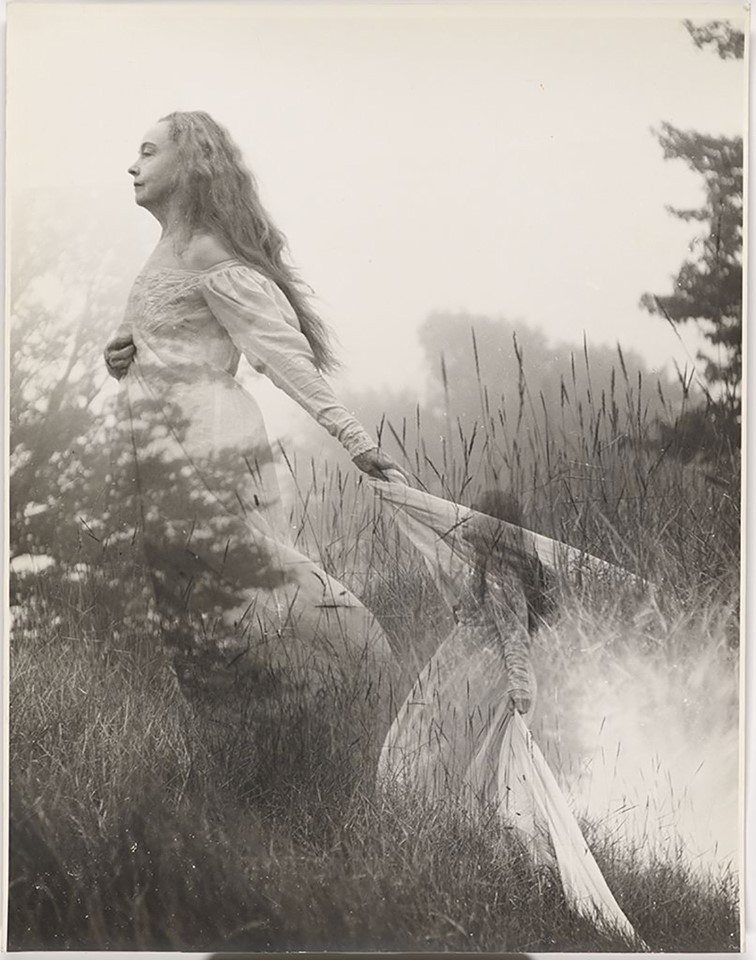
The uncanny artworks of Dora Maar include double exposures, photograms, and photomontages, often imbued with a sense of melancholy and tenebrosity, depicting scenes ranging from the poetic solitude and ambiguity of Parisian boulevards and urban life, to unconventional representations of fashion, erotica, symbolic self-portraits, and figures and silhouettes viewed from strange perspectives, as well as ghastly creatures. One of her most iconic images, the delicate hand crawling out of the shell on a desolate beach surrounded by an ominous skyscape with apocalyptic clouds, is filled with grace, vulnerable elegance, frailty, doom, nostalgia, as well as a strange erotic quality. The juxtaposition of elements creates a surreal dreamlike narrative. In addition to her surreal art, the artist also approached and represented the world realistically, through natural photographic captures of simple, seemingly unplanned moments, visual vernacular, and candid narratives within the urban space.
Dora Maar has been known as the model, muse, and lover of Picasso, whose dark portrayal of her in his work-particularly in “The Weeping Woman” as a suffering, tortured, yet monstrously threatening figure- she vehemently rejected, declaring that all his depictions of her are deceptions with no link to her character.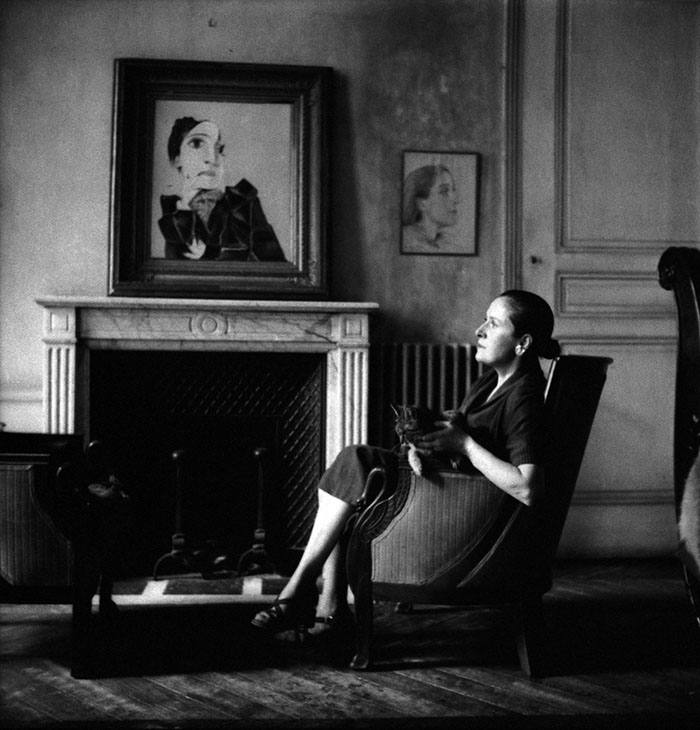
Dora Maar photographed by Lee Miller in her Paris home cca 1956. Featuring a Picasso portrait of her on the mantelpiece. Captivated by her beauteous transfixing appearance and intellectual and artistic brilliance, Picasso developed an obsession with painting her in a multitude of ways, albeit distorted, stylised ways, blending various personal themes with his subject. Dora Maar often painted portraits of Picasso and other members of the surrealist circle. She was also photographed and influenced by renowned surrealist photographer Man Ray. Brassai described her saying that she had “bright eyes and an attentive gaze, a disturbing stare at times”, whilst James Lord poetically painted her inner and outer beauty in words, also starting with the windows of the soul: “Her gaze possessed remarkable radiance but could also be very hard. I observed that she was beautiful, with a strong, straight nose, perfect scarlet lips, the chin firm, the jaw a trifle heavy and the more forceful for being so, rich chestnut hair drawn smoothly back, and eyelashes like the furred antennae of moths” (J. Lord, Picasso and Dora, New York, 1993). After parting ways with Picasso, she was treated by French psychoanalyst Lacan and eventually decided to embrace the path of solitude and mysticism, whilst still expressing herself through various forms of art.
The exhibition provides an amazing opportunity to explore the complex, bewitching, enigmatic inner world of the woman whose distinguished work and artistic identity have often been eclipsed by her legendary association with the famous cubist artist.
Dora Maar’s work is exhibited at Tate Modern until 15 March 2020.
William Blake

 The Agony in the Garden c.1799-1800 William Blake 1757-1827 Presented by the executors of W. Graham Robertson through the Art Fund 1949 http://www.tate.org.uk/art/work/N05894

 Pity c.1795 William Blake 1757-1827 Presented by W. Graham Robertson 1939 http://www.tate.org.uk/art/work/N05062
Mesmerising, mystical, soul-stirring artworks from the allegorical universe of William Blake. Born in Soho, London, Blake was a fascinating artist whose work was misunderstood and deemed to be a sign of madness by his contemporaries, being far ahead of its time due to its expressively dark, sacrilegious nature and the sometimes grotesque creatures depicted. His work received merit and recognition mostly posthumously, as he is now one of the most highly revered English poets and visual artists. The artist’s work was fuelled by the otherworldly visions he started experiencing from a young age. His iconic, symbolic imagery features faeries, devils and angels, fictional deities invented by him- embodiments of philosophical concepts governing his universe, other religious and celestial themes, suffering, sexual violence, scenes from Dante’s Divine Comedy, as well as Miltonic and Shakespearean characters. As it can be observed in the images above, there is a mixture between the ethereal & the sinister in his depictions of angelic beings and blissful scenes and dark, hellish ones with titles such as “The Number of the Beast is 666” and “The Agony in the Garden”.
The Times exhibition review: “Find yourself transported into strange, enraptured realms.”
“To see a World in a Grain of Sand
And a Heaven in a Wild Flower,
Hold Infinity in the palm of your hand
And Eternity in an hour.”– William BlakeWilliam Blake’s oeuvre is now on exhibition at Tate Museum until 2 February 2020
Katie Eleanor: “The Sialia Marbles”


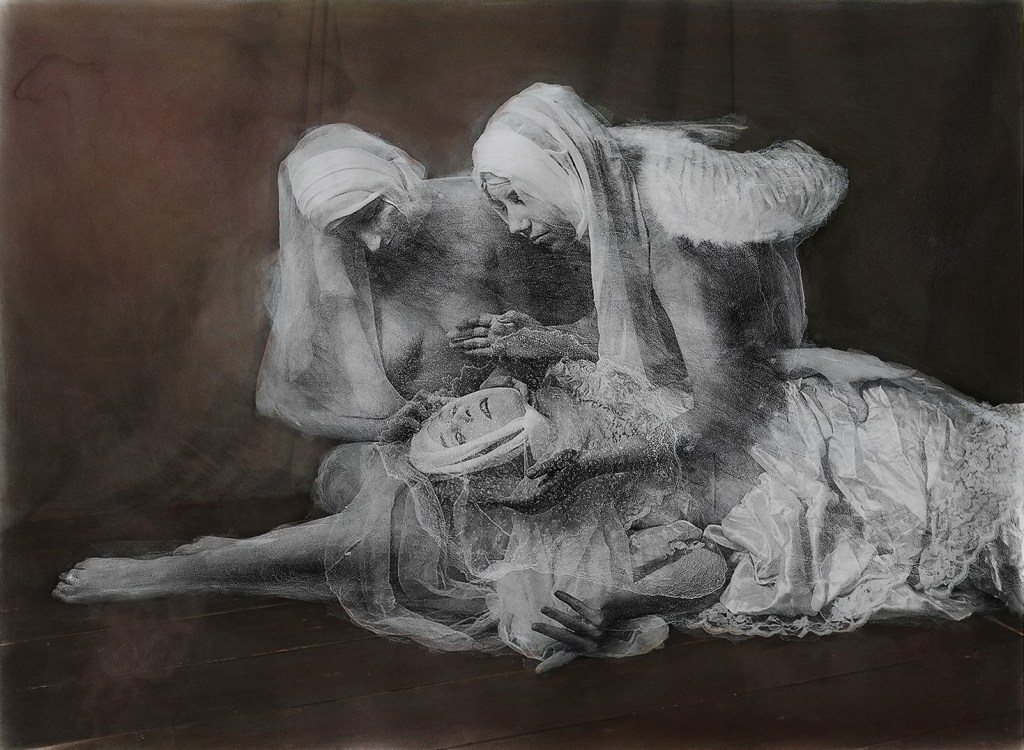
Katie Eleanor is a London-based contemporary fine art photographer and Photographic Arts Graduate from the University of Westminster. Inspired by marble sculptures, the sculptural nature of Oscar Gustave Rejlander’s artworks, as well as scenes and characters from myths and from the artist’s fictional world, artistic memory, or, as she evocatively refers to it, the museum of her mind, “The Sialia Marbles” exhibition features hand-coloured photographic prints depicting ethereal beings frozen in time, marble-like, sometimes angelic-looking, other times ghostly. The uncanny dimension of her artworks stems from the dichotomous interplay between liveliness and death, between the ephemeral and the immortal qualities of her art; the rigidity and physical longevity of marble statues and the fluidity and ephemerality of the human performer; the deathlike stillness and the implication of physical and emotional movement. The beings depicted are also characterised by the archetypal (sentient-inanimate) ambiguity belonging to the Uncanny Valley.
The tableaux of Katie Eleanor allude to religious iconography and mythology art, with some subjects appearing to be solemn, others dramatic, involved in intense narratives. The veiled, white, diaphanous subjects portrayed are reminiscent of spirit photography, which amplifies the uncanny effect. It’s as if we are waiting for the motionless inhabitants of these unknown worlds to transcend the parameters of their existence within art; waiting for them to move towards the edge of the frame or fade away, for their veils to slip and reveal a change in expression, for their eyes to meet ours or glow. At the same time, the resemblance with statues (thus with something inanimate) makes this expectation perplexing.
The process behind the images includes the ritual of painting the models, performing a scene, the post-production process of hand colouring and enhancing the texture of the black and white analogue photographs. “Sialia” is the scientific name for bluebird – which Katie mentions is her alter ego, and the choice to include the word ‘marbles’ in the series title is congruent with her museum without walls parallel- a collection of uncanny human statues from her imaginary museum. The use of analogue photography and old film techniques brings uniqueness to the artworks; the physical, haptic quality of her work makes it more memorable and evocative, taking us on a mental trip through photographic art practices and through history, bringing back cultural artefacts and the sensory, magical properties of photography belonging to the pre-digital age. In more ways than one, Katie Eleanour’s photographs transcend temporality, having a hauntological dimension.


“I love tableaux vivants and creating intense, ambiguous scenarios with my performers. Angels are found in so much religious and historical visual culture, so they are familiar. They also symbolise protection, particularly when the series is viewed as a whole. I am not a particularly religious person, but I believe in sanctuary. My brain and my imagination are my sanctuary, and that is something I associate with these solemn spaces. It’s all creating a sanctuary for the viewer to inhabit, a sense of stillness and introspection.” – Katie Eleanor, Image Journal interview, 2019
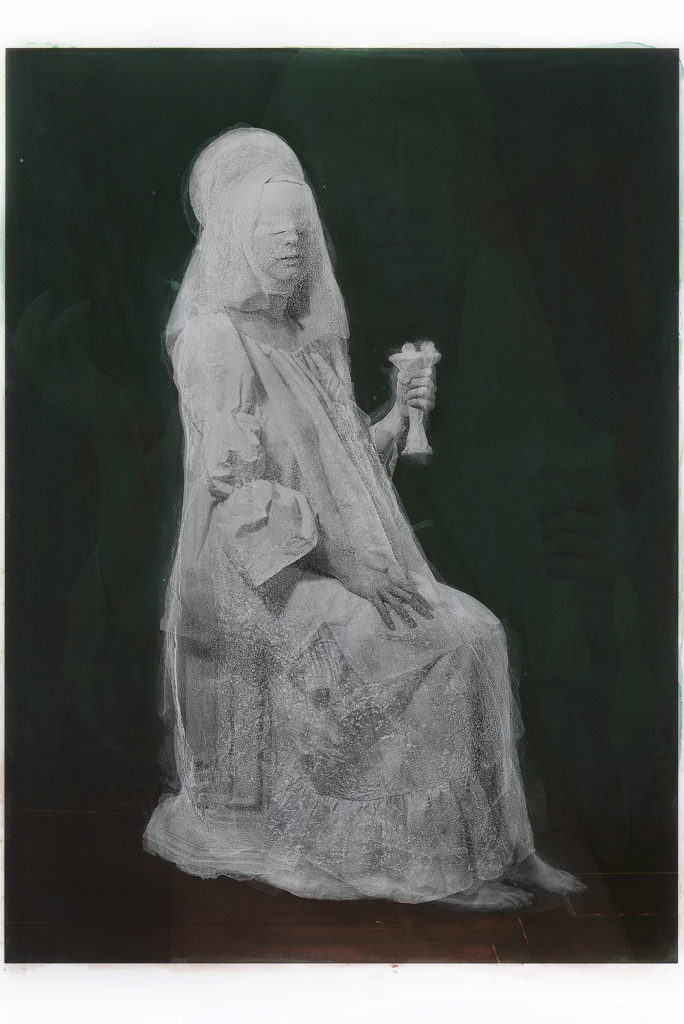
Saint Lucy by Katie Eleanor Among the figures depicted in her work, you can find Saint Lucy and Daphne. After seeing a painting of Saint Lucy by Francesco Del Cossa, displayed at the National Gallery, the artist reveals:
“I was struck by the contrast between the brutality of her story and this ornate, delicate, almost whimsical rendering. In my version, the bandages over her eyes are significant, as I find the eyes of sculptures particularly haunting and vacant. This piece is a kind of homage to an amazing character in history.” – Katie Eleanor, Image Journal interview, 2019
“The Sialia Marbles” collection is on show at MMX Gallery until 15 February 2020
Other exhibitions:
Tim Walker – Victoria and Albert Museum until 22 March 2020
Tutankhamun: Treasures of the Golden Pharaoh- Saatchi Gallery until 3 May 2020
-
Motionless
It’s my first time. Half of my motionless body rests inside the white, clinical, cylindrical machine, in my head resembling an intergalactic coffin. I feel an itch, but I have to resist moving. I want to cough, to sneeze, to yawn, ugh, of course, at the most inopportune moments, and I have to keep it under control and be still. My legs are too tense, my lower body feels heavy. I am mentally calm. But my body wants permission to move. Since this is just a brain scan, I try to make a slight leg movement, but it feels like trying to lift an anchor. My mind keeps freezing. There is the buzz. It’s getting louder. And stranger. Then the clanking. The whirring. Suddenly thoughts of the few MRI safety incidents and fatalities I’ve read about vaguely infiltrate my mind in a weirdly serene way. I should have double-checked there is definitely no metal anywhere in or around this room. Oh come on, when something like this enters my mind, I think – what are the odds? and what is the point of obsessing over the odds?- and the thought melts away. I can remember basic aspects about my life, but there is something peculiar about this eerily cold, sterile room, this atmosphere; it’s holding back any specific memories, any feelings, any complex thoughts- I can’t really visualise anything about my past or about life outside this tube. I mean, the noise is quite obstructive, so whenever a thought or a mental image starts materialising, it quickly dissolves. I have a rare, evanescent, uncanny feeling that there is a higher presence or force watching over me. This reminds me of my pre-atheistic, childhood days when I had an agnostic belief in animism and in magical thinking- the belief that one’s thoughts could influence reality, which was problematic whenever I had dark, “forbidden”, ungodly thoughts resulting in fear of divine punishment and futile attempts at suppression. There is a surreal atemporality about this space, it’s like reality is suspended. If my whole body slid into this alienating horizontal cylinder, it would really feel like I’m inside an eccentric, futuristic coffin. That’s spine-chilling. And yet, despite my claustrophobic tendencies, I wish I had a full body scan so I could be encapsulated and see what it would be like if my consciousness or my spirit found a way to return to my corpse a hundred years from now. I don’t believe in it, but I like fantasising. My ego is temporarily numb and any vivid memories are gone, replaced by brief, fleeting perceptions, and it’s one of the few moments in which I’m not living in the past or in the future. I’m living in the now. I feel alive and calm, oddly calm. An oddly calm combination of cells, lying down in a tube, with an ego on snooze mode. Oh, it’s time to get back out there…
-
Various poems
Catatonic state
I feel your ashes
like quicksand
I’m sucked into
so I’m standing still
trying to enjoy the view.Your faith
I never confessed this but
your faith helped keep me
anchored in myself
whenever the currents started
hitting from all sides.
I just wanted to thank you
for still existing in my mind.Extensions
Extensions of me
are ramifying under
your skin.
Does it hurt when
I unravel your bloody
nightmares?Discrepancy
As you weed them out,
slowly, the space between
you and the other you-
both mental concepts-
will become smaller
and smaller
until they merge into one
at which point you will look
around, filled with life,
no longer tainted, you will
open your eyes and see
the discrepancy is abolished
but so is everyone else. -

Pleasures in life
My happiness is sometimes derived from:
The scents of acacia flowers, honeysuckle and snowdrops; the taste of greengages.
Moments when I feel I love what I am doing: when I get excited while reading research or creative writing – and, consequently, when I feel like I can contribute to the research or I can create stories – either through words or photographs. When I am inspired – to create and to live fully.
Meeting people I truly connect with. Everything is genuine and pure, everything flows, the masks are left aside, and no one questions another’s words or feelings. You just know what is happening, share the same smile, and are able to live, truly live in each other’s company without performing. The feeling of belonging.
Peace of mind, in general, or moments of blissful lightheartedness. When every veil of worry, gloom or heaviness is lifted up and I feel unconditional love and self-love within. This is also when I can appreciate every simple aspect of being. It even feels like my body is lighter, like I float, just as my thoughts do.
Wandering in fantasy worlds reminiscent of my childhood.
Running. Setting goals and accomplishing them.
Finding a film I am profoundly touched by. If you know me, you know how intensely I can immerse into films. I become the character, I live the films when I watch them. The pleasure consists in the experience itself, in losing and finding yourself in a concept or a story. It can be revealing, too.
Adventures. waterfalls. explorations in nature; admiring its grandeur, but also the grandeur of an old temple or a rich urban or futuristic noir-looking area.
Those rare moments my writing always eventually comes back to; the ones I try to grasp through words, but fail. Those surreal moments.
Living in a place decorated by me, where I can have my own space, a secret garden where my pet would dwell, and arch-shaped windows. The decor would be elegantly dark in some rooms, fantasy-like in others, and there will be at least one room with everything in it white and light (see Valerie’s room from “Valerie and her Week of Wonders”). There would be Gothic art, paintings spanning different cultures, motifs, and ages – with a preference for Pre-Raphaelite depictions of mythological scenes, candlelit rooms at night, and classical and dark atmospheric music filling the hallway. Ideally, I’d have this variety of design styles to suit my whims.
To mention a one-off: Hearing Sharon den Adel’s angelic voice for the first time, and seeing her on stage at Artmania Festival.
What makes you happy?
-
British Cemeteries
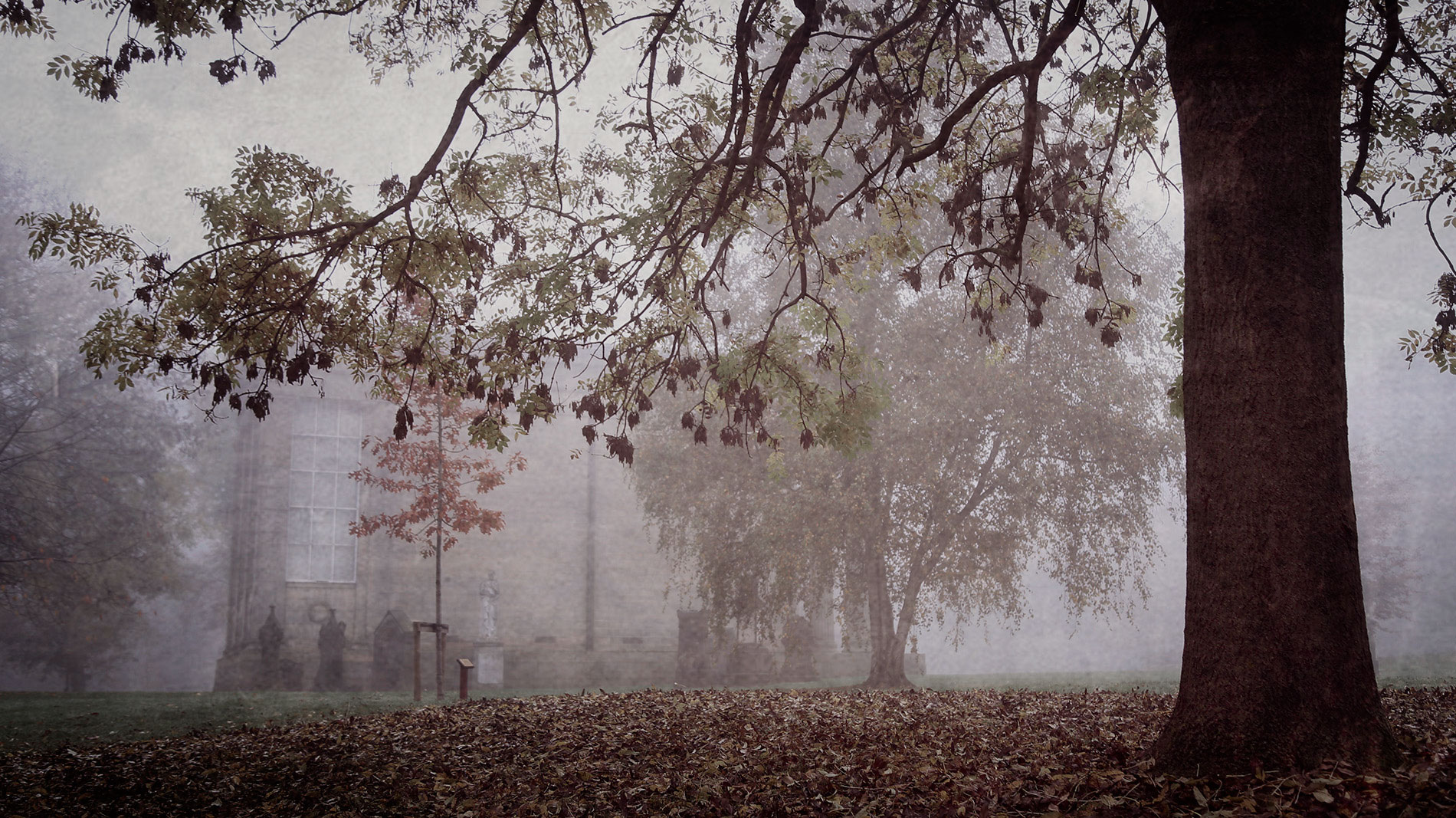
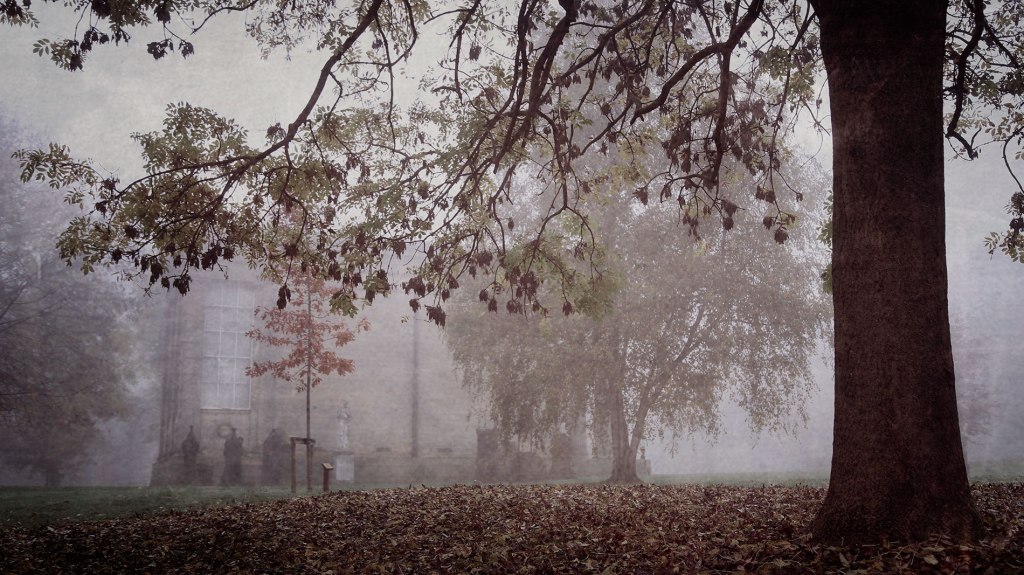
“A Dream within A Dream”
St Georges Fields, the former Woodhouse Cemetery, is the perfect place for eerie strolls. When architecture and trees submerge in the dreamlike fog, everything looks surreal.
 DIANA MARIN