Kriyā and the Art of Alignment: Writing from the Self

There’s a passage in The Artist’s Way that has stayed with me, one where Julia Cameron introduces the concept of Kriyā, a Sanskrit term meaning “action”, but which she expands to describe a kind of spiritual crisis — a deeper, almost visceral reaction we have when something in our life is misaligned. It’s the pain that hits right after we force ourselves to endure something we shouldn’t. The exhaustion that follows overcommitment. The anxiety that builds when we ignore our creative instincts. The psychosomatic warning system that lets us know when we are forcing ourselves into a life that doesn’t fit. A kriyā is the body saying, “Enough.” It’s a warning from the self we’ve ignored for too long.

She describes how, when we ignore our truth — whether by working a job that stifles us, overcommitting to obligations that drain us, or even rescuing people who should be rescuing themselves — our body protests. We get sick, anxious, lethargic. Our emotions flare up, and our energy vanishes. Cameron’s Kriyā, in this sense, goes beyond simply taking action; it requires recognising when the actions we are taking are working against us.

Through morning pages and self-reflection, we begin to see where we are out of sync. At first, this clarity feels like loss.

“I can’t keep ignoring my health or sacrificing my time for this job. Or “I have outgrown this job.”
“This relationship isn’t working.”
“I don’t enjoy this anymore.”

Realising these things can be painful. We often resist. We want to keep the illusion that everything is fine. We don’t want to change — we want things to change for us. But as Cameron points out, once we eliminate ambiguity from our lives — when we become clearer about who we are, what we want, and what we stand for — we also lose illusion. And while losing illusion can feel like a loss, it is also a gift. We gain something invaluable: the truth.

And yet, truth doesn’t arrive gently. It disrupts. It can bring tears and frustration. Cameron compares this process to a spiritual seizure, an upheaval that shakes us until we let go of what no longer serves us. This is where art and self-expression come in — not as an escape, but as a way to process and understand this shift.

One of Cameron’s most striking ideas is that as we clarify who we are, our creative voice becomes coherent. When we are fragmented — when we suppress parts of ourselves to fit into jobs, relationships, or roles that don’t align with us — our creative work reflects that fragmentation. It feels scattered, disconnected. It lacks a centre. But as we strip away the false selves, as we clear out the clutter — physical, emotional, psychological — our writing, our art, begins to feel like it comes from the same person. A pattern emerges.

She calls it the snowflake pattern of the soul — a unique, intricate identity that takes shape once we shed false layers. The more we remove what is not ours, the more distinct our pattern becomes. And when we create from that place, our work has coherence, continuity. Our writing, our art, no longer feels like it was made by multiple conflicting selves but by one true self.

Also, writing (or any creative work) involves tuning into what is already within us, rather than inventing something outside of ourselves. And that means confronting our real emotions, our real desires, and our real experiences. This is why Cameron insists that creativity is not based on fantasy — it is rooted in reality. Art happens in the moment of encounter: when we meet our truth, we meet ourselves. And only by meeting ourselves can we create something original.

She seems to emphasise the following points:

1. Listen to the kriyās. Pay attention to where life feels wrong, where you are forcing things. Let yourself feel the loss of illusion.
2. Write from clarity. As you refine your self-understanding, your art will refine itself too. Your writing will begin to feel like it flows from one true voice, not a chorus of conflicting selves.

Beyond its myriad interpretations and purposes, art is about becoming someone. Becoming the person who can create freely, without distortion. And in that becoming, as we align with who we truly are, our voice, our art, the snowflake pattern of our soul will finally emerge — whole, authentic, and coherent.

According to Cameron, writing (or any creative act) therefore requires a stable sense of self. We need to know, at least on some level, who is speaking in order for our voice to emerge authentically on the page. If we are constantly shifting to accommodate external expectations, our work will feel scattered, fragmented, and uncertain — reflecting the uncertainty within us. To write from the self, we must first reclaim it. We must listen to our Kriyā, recognise where we are out of sync, and make adjustments — not just in our creative work, but in our daily lives. The more we align our actions with our deeper truth, the more naturally our words will flow.

That said, I don’t fully agree with the idea that writing requires a singular, stable self. Writers like Whitman, Virginia Woolf, and David Hume remind us that identity is not a fixed entity but a shifting constellation of thoughts, perceptions, and impressions. Whitman famously declared, “I contain multitudes” while Woolf wrote, “I am rooted, but I flow”, suggesting that while parts of us are fluid, ever-shifting, there is also a deeper, more unshakable core — something immutable that makes us who we are. Hume, on the other hand, challenges even this notion of a stable self, asking, “When you enter most intimately into what you call yourself, what do you find?” His answer: a collection of perceptions in perpetual motion, never truly fixed.

In my case, the fluidity in my writing does not stem from accommodating external expectations; rather, it emerges from exploring the fluidity of the self itself. Creativity allows me to move between different facets of my identity, to express contradictions, to embrace the shifting and evolving nature of being. Even to dream myself into another existence. Rather than seeing this as fragmentation, I see it as expansion — writing as a way of capturing the many selves that exist within me, rather than fixing them into one.

At the same time, there is work to be done in letting go of how my writing will be received. It’s easy to fall into the trap of thinking about how something might be interpreted, whether it will make sense to others, or whether it aligns with an external narrative. But ultimately, what matters most is this is how it feels to me. Writing from that space — without worrying about how it will be perceived — feels like the truest way to honour both the clarity and the fluidity of self-expression.
A Brief Journey Through Strangely Familiar Narratives in Contemporary Collage Art

Collage art constitutes a dynamic medium where elements of the familiar are unsettlingly displaced into unfamiliar territories, offering a visceral exploration of the uncanny. Teetering between the comfort of recognition and the chilling thrill of the unexpected, the realm of contemporary collage art opens up a world of paradoxes, where the mundane is rendered extraordinary and the predictable unexpectedly disrupted.

My recent article at the Uncanny Archive, “Strangely Familiar Visual Narratives: An Exploration of the Interplay between Reality and Unreality in Contemporary Collage Art”, highlights the striking, haunting works of some contemporary collage artists who have had a real impact on various social media platforms. The artists weave evocative visual narratives, each standing out with a distinctive approach to the medium by employing their unique artistic vernacular to translate the ethereal, the uncanny, and the nostalgic into tangible, visual experiences.

These contemporary collage artists, albeit divergent in their techniques and thematic focal points, share a predilection for the provocative interplay of reality and unreality, echoing the unsettling familiarity of the uncanny in their otherworldly compositions. With techniques crossing the realms of both digital and analogue – such as utilising archaic photographs, drawings, magazine fragments, and ephemera from antiquated encyclopedias, the digitally impactful artists craft narratives that mesmerise, evoke feeling, stimulate the mind, and spark our curiosity.

Conceptually, they achieve this in various ways, from incorporating familiar objects in strange contexts and vice versa, resurrecting aesthetics and figures from the past which become merged with the present, adding elements from celestial bodies and the untamed natural world as well as layers of subtle commentary, embellishing images with crystals and glitter to promote body image positivity and emotional transparency, and creating an atmosphere that is at times nostalgic, other times ethereal or eerie. Their universe encompasses the Victorians, mythology, religious iconography, silent cinema, French New Wave cinema icons, fashion, pop culture, and more.

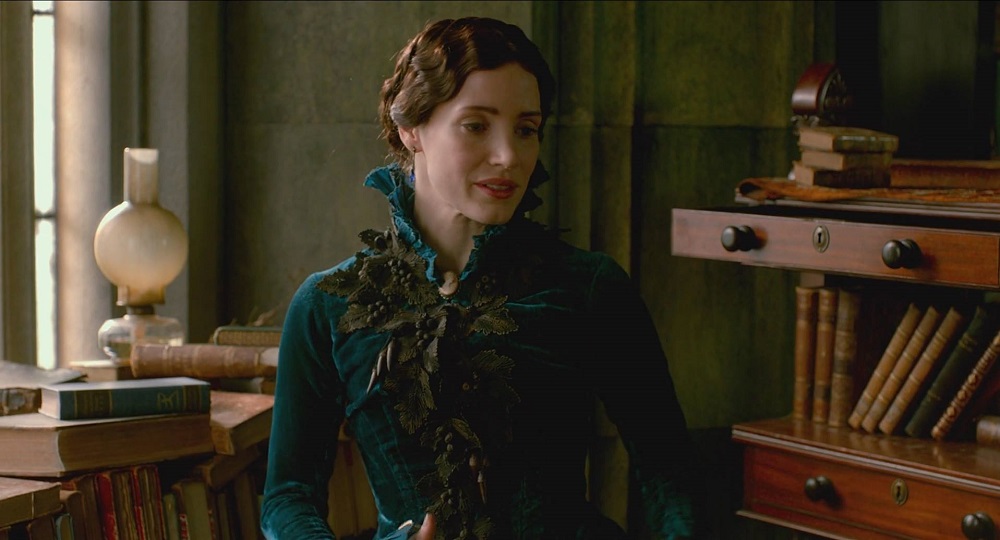
Costume design symbolism in Crimson Peak (2015): Lucille’s breathtaking blue velvet dress

crimson-peak-lucille-blue-velvet-dress-symbolism

Crimson Peak (2015), directed by Guillermo del Toro, is a visually stunning, gloomy cinematic horror spectacle, noted for its incredible and haunting aesthetic. A particularly remarkable and alluring feature of the intricate production design is Lucille’s breathtaking blue velvet dress. The bewitching symbolically-charged Victorian design of the dress includes a black garland resembling a vine with withered leaves, claustrophobically climbing towards her pale neck. The owner, played by the mesmerising Jessica Chastain, is a beautiful, tense, frigidly graceful corset-wearing ice queen filled with dark repressed emotions, whose attire reflects her inner state. Her blue, heavy rigid dress seems to blend with her eerie funereal surroundings, the underwater feeling given by the aquatic colours and the flickering interplay of light and darkness, the dark curtains, and the grandiose blue walls of the Gothic mansion. She is tragically connected to the ominous house and the dead vines tangled up around her body further anchor her in it, symbolising her psychological confinement. She is often shown in contrast to pure, innocent, and lively Edith, played by Mia Wasikowska, who wears light and loose gowns.

The adapted version of The Proust Questionnaire

As a fan of Marcel Proust who loves the way he perceives the world as depicted in À la recherche du temps perdu, I thought I should write down my answers to the most popular version of his iconic questionnaire in my first unequivocally personal blog post, even though my answers may very well change tomorrow:

What is your idea of perfect happiness?
Time travel. Interplanetary travel. As for a slightly more down-to-earth answer, visiting the most beautiful, inspiring- ethereal or eerie- places, absorbing every moment spent there and feeling connected to the place, living in the present, and having a cultivated soul.

What is your greatest fear?
Death. Non-existence. Annihilation. Oblivion. Aging. Bugs.

Which historical figure do you most identify with?
Literary figures: Virginia Woolf & Sylvia Plath.

Which living person do you most admire?
Tilda Swinton. Richard Dawkins. David Lynch. Plus anyone who positively influences the world, who is aware of the whole picture and manages to focus on the good rather than the bad in the world, overall.

What is the trait you most deplore in yourself?
I will mention a few, although I have conflicting feelings about these traits as I don’t always deplore them: cynicism, the low-key need to be in control, fickleness in some respects, ricocheting between emotional frostiness and impulsiveness, scepticism to the point where I start being sceptical of my own scepticism, and taking myself too seriously (but otherwise I probably wouldn’t be able or feel propelled to write!).

What is the trait you most deplore in others?
Duplicity, hypocrisy. Prejudice. Lack of empathy and inability to listen. Arrogance. Wrong life values. Underestimating me.

What is your greatest extravagance?
My luxury perfume collection. Not sleeping at night.

What is your favourite journey?
towards self-awareness and self-development, through self-indulgence and creative fulfilment.

What do you consider the most overrated virtue?
Patience. Sympathy (not empathy). Contentment. Humility and prudence in women’s case. 

On what occasion do you lie?
When the conversation doesn’t matter, or when I’m convinced that telling the truth wouldn’t be beneficial to anyone involved. 

Which living person do you most despise?
anyone who uses their power to negatively influence, harm, ruin, or eradicate the lives of innocent people, either on an individual level, or on an organised level.

Which words or phrases do you most overuse?
aesthetic. surreal. oh my god. yeah. no.

What is your greatest regret?
caring when I shouldn’t have. not caring when I should have.

What or who is the greatest love of your life?
perfume, cinema, music, labyrinthine architecture

When and where were you happiest?
I don’t remember exactly but I’m gonna say it was probably a case of frisson- “aesthetic chills”- that I experienced whilst watching a hypnotic, revealing, or epiphany-inducing film or piece of art.

Which talent would you most like to have?
a mesmerising, emotion-inducing, magical singing voice.

What is your current state of mind?
introspective. conflicted.

If you could change one thing about yourself, what would it be?
I’d give myself an infinite dose of productivity and the capacity to love the world freely and unconditionally. Getting rid of grudges. Being less fickle/wishy-washy in some respects.

What do you consider your greatest achievement?
rising from the flames like a Phoenix.

If you were to die and come back as a person or thing, what do you think it would be?
a fairy or a nymph.

What is your most treasured possession?
my perfume collection, my films collection, my velvet dresses collection,

What do you regard as the lowest depth of misery?
not living the life you want, letting obsessions or demons consume you, feeling trapped.

Where would you like to live?
in a beautiful place adorned with paintings and different styles of decorations on each floor or in each room (Gothic, minimalist, dreamy, airy fantasy style etc). Also, in the distant future, maybe on a different, ultra-advanced planet. Either that or in one of the many film fantasy worlds I love.

What is your favourite occupation?
maladaptive daydreaming

What is your most marked characteristic?
being artistically-inclined. being headstrong, perceptive/astute, experiencing derealisation and zoning out (this sounds contradictory to the astuteness, but it’s actually not!); inquisitive, independent-minded, and a freethinker. looking sad or annoyed when I’m actually in a neutral or thoughtful mood.

What is the quality you most like in a man?
Intelligence (including emotional intelligence), genuineness, confidence -not cockiness, self-awareness

What is the quality you most like in a woman?
strength, genuineness, intelligence, confidence, self-awareness

What do you most value in your friends?
kindness, authenticity, having my best interests at heart, trustworthiness, & respecting confidentiality

Who are your favourite writers?
Virginia Woolf, Sylvia Plath, Baudelaire, Oscar Wilde, Vladimir Nabokov, Hermann Hesse

Who is your favourite hero of fiction?
Jessica Jones, Vanessa Ives, Jean des Esseintes, Violet Baudelaire, Rogue

What do you dislike most about your appearance?
I like my appearance overall, but there are two or three things I would/will probably change if I can.

Who are your heroes in real life?
Inspiring women who are unapologetically fierce and do whatever they feel like (unless they are psychopaths or something equally worrying).

What are your favourite names?
Morgana, Diana, Ariadna, Mordred, Crystal.

What is it that you most dislike?
pity, prejudice, labels.

How would you like to die?
Knowing that I will be revived as an immortal goddess, mostly because I want to live forever, but all the other perks would be fun too!

What is your favourite motto?
Do no harm, but take no shit. // C’est la vie. //
Incantation-“You must not ever stop being whimsical. And you must not, ever, give anyone else the responsibility for your life.”
Quotes-“I stopped explaining myself when I realised other people only understand from their level of perception.”
“There are only two tragedies in life: one is not getting what one wants, and the other is getting it.”
“Everything in moderation, including moderation.”
“To love oneself is the beginning of a life-long romance”


Write your own answers to all or some of these below, I’m interested to see!

Review: Mira Nedyalkova’s underwater photography

A selection of artworks from the stunning, eerie underwater photography collection by Bulgarian visual artist and fine art photographer Mira Nedyalkova.

Mira’s work depicts the beautiful facets of pain and sadness in fluid forms, whilst linking water with sensuality and exploring erotic and emotional themes.

Water symbolism always makes us think of regeneration, purification, and catharsis – a reflection of the beginning and the end. Mira emphasises the dual dimension of water, symbolising sin and purity, as well as pleasure and innocence. The aquatic element has both generative and destructive powers; it can be life-giving and apocalyptic. Her models are depicted as otherworldly beings, seemingly frail, yet also dark and enigmatic. Water is also the essential element contributing to the surreal aesthetic of the pictures, since it changes the light, colour, and shapes captured in unexpected ways.

Mira Nedyalkova is not interested in pure photography – as opposed to many photographers who praise raw analogue photographs for capturing unaltered moments, she recognises the creative and transformative power of post-processing and digital editing as a way of enriching photography, of creating something new, conveying an emotion, and telling a story. As a former painter, she now sees digital editing as a way of getting closer to painting again.

Like many artists, Mira believes emotion is an essential part of a remarkable piece of art. Her view is epitomised in her stunning, memorable photographs, often depicting expressive, intense characters found in captivity. Other recurring characteristics of her artistic vision are a preference for nudity, the eerie beauty of nature, enigmatic, fragile-looking animals, and subtle sexuality.