Tag: horror films

  • Costume design symbolism in Crimson Peak (2015): Lucille’s breathtaking blue velvet dress

    Costume design symbolism in Crimson Peak (2015): Lucille’s breathtaking blue velvet dress

    crimson-peak-lucille-blue-velvet-dress-symbolism

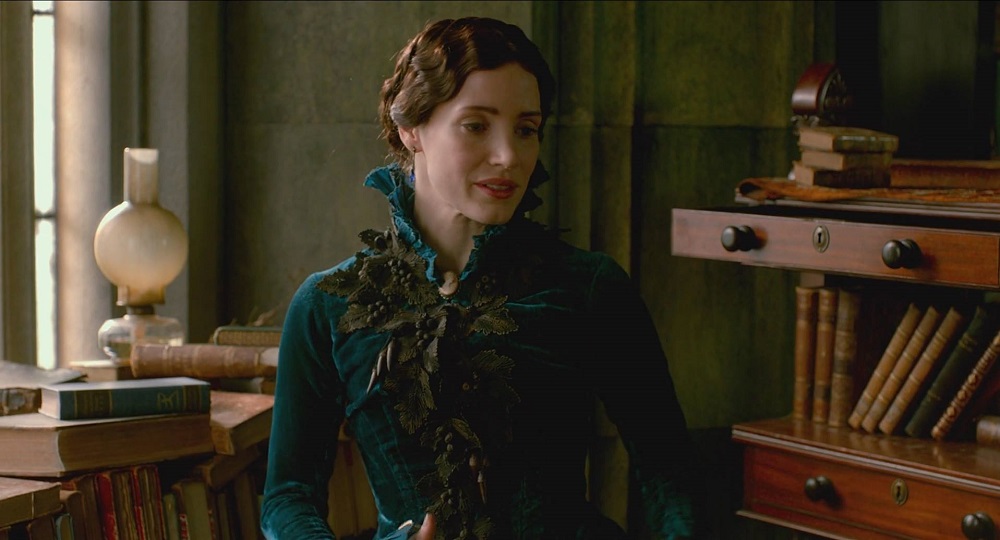
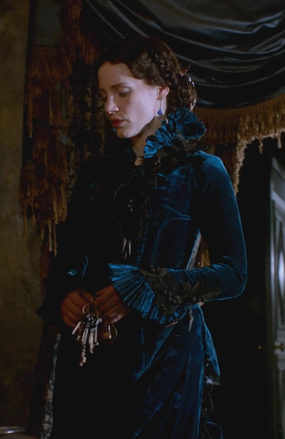
    Crimson Peak (2015), directed by Guillermo del Toro, is a visually stunning, gloomy cinematic horror spectacle, noted for its incredible and haunting aesthetic. A particularly remarkable and alluring feature of the intricate production design is Lucille’s breathtaking blue velvet dress. The bewitching symbolically-charged Victorian design of the dress includes a black garland resembling a vine with withered leaves, claustrophobically climbing towards her pale neck. The owner, played by the mesmerising Jessica Chastain, is a beautiful, tense, frigidly graceful corset-wearing ice queen filled with dark repressed emotions, whose attire reflects her inner state. Her blue, heavy rigid dress seems to blend with her eerie funereal surroundings, the underwater feeling given by the aquatic colours and the flickering interplay of light and darkness, the dark curtains, and the grandiose blue walls of the Gothic mansion. She is tragically connected to the ominous house and the dead vines tangled up around her body further anchor her in it, symbolising her psychological confinement. She is often shown in contrast to pure, innocent, and lively Edith, played by Mia Wasikowska, who wears light and loose gowns.
  • Vampyr (1932), dir. Carl Theodor Dreyer

    Vampyr (1932), dir. Carl Theodor Dreyer

    “I wanted to create a waking dream on screen and show that horror is not to be found in the things around us but in our own subconscious” — Carl Theodor Dreyer about his film, Vampyr (1932)

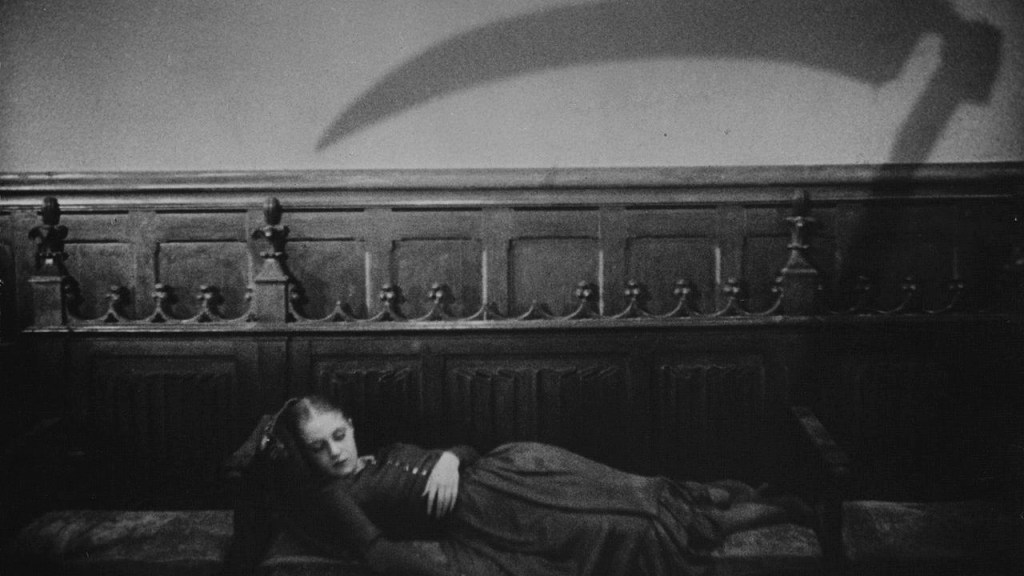
    Vampyr is a hypnotic and claustrophobic mix of eerie images featuring surreal elements shown through an interplay of light and darkness, disorienting geography and camera movement, morbid shot compositions, and occult symbolism. Some thematic elements are obscure sickness, a man’s shadow coming to life, the iconic horror film sight of the man with the scythe, constantly misty weather, and nightmares about being buried alive.

    The chambers of the abandoned buildings are metaphors for the rooms of the mind. Any lines between reality and nightmare appear to be blurred. Allan, the dreamer, has an obsession with the occult, and his perspective is sometimes ambiguous, seemingly unreliable. Through the technique of superimposition, his identity is split, and a ghostly image of him emerges.

    The haziness of the shots was initially accidental, due to light exposure; then Dryer decided this aesthetic was suitable for the concept of the film and adopted the look using translucent fabric over the lens as a texture and soft focus photography.
    The elusive and ephemeral quality of the film is also given by the fact that some of the material was lost, some of it was later restored and re-edited, and the film exists in different versions.