Category: writing

  • Life observations and tips on how to pass through life with awareness

    – Empowered people contribute to the empowerment of those around them.
    – Avoid judging things at surface level. You need to dig a few layers deeper without closing your eyes when you find treasure rooms or catacombs. On the surface, you might be trapped in a Fata Morgana.
    – It’s true that high expectations often lead to disillusionment with the world; however, as long as you don’t let yourself be disillusioned with your self, high expectations can be used as fuel to build and improve your life.
    – Falsity contaminates. Authenticity inspires; it’s contagious, enveloped in light, and arouses kindness. Its adepts are a dying breed, so value them.
    – We all have both light and darkness within us. Some will see the angelic, others the devilish, and such judgements are partly reflections of the watcher. I wouldn’t say you should never see yourself through the eyes of another as that could inhibit empathy and diminish your humanity, or simply prevent positive things from happening- instead, be selective of the eyes you borrow, why, and when…
    – …and whatever you do, never lose your own vision, lest you be swallowed by the mouth of the world and become a watered-down version of yourself.
    – Sometimes you won’t know if something is right or wrong for you until you try it. If you realise it feels wrong, give up. If it feels right, carry on, regardless of external views. Not all compasses for life navigation reveal the same directions.
    – Your beliefs, perspective on, or perceptions of many subjects will shift over time. This can manifest in your response to and interpretations of the world around you, which can, in turn, re-shape your world.
    – You should create your life, not just react to it. Relinquish fatalistic views.

    – Don’t fall into toxic ego traps.
    – As you age, years start flying by in a blink. I’m young, and I already feel life slipping away so quickly. Don’t live in the past and don’t spend too much time lamenting the death of past moments or things that are out of your control.
    – Don’t become complacent. If you ever feel ‘there is more to life than this’, whether you’re thinking of your job, lifestyle, or experiences, you are probably right. Explore and feel new things, pump up your dopamine and adrenaline levels. Take risks, but have a safety net.
    Embrace who you are. Maybe in your adolescence and your twenties that’s a meaningless or elusive statement since you’re constantly learning new things, going through changes, growing as a person. Well, hopefully your whole life will consist of that. But embracing yourself encompasses that fluidity too, it means giving yourself a break, recognising all aspects of yourself and accepting them (if they’re not harmful or toxic). It’s okay to cultivate happy thoughts and it’s okay to be cynical sometimes. It’s okay to be funny and it’s okay to be serious. Intense and light-hearted and giggly. Sociable and reserved. Impulsive or stoic. It’s okay to explore your provocative side and it’s also okay to be timid.  To see yourself as a collection of thoughts and memories. To be made of many things, without any single aspect defining you by itself. It’s okay to be real.

  • A poem: Evocation

    There was nothing left
    except her orange blossom scent
    in the air,
    her skin cells
    on the conspiring blanket,
    the energy he was feeding off
    and her seraphic aspirations,
    elegantly penned
    in a forlorn diary
    before her concept
    of the world expanded into
    postmodern depths and
    her self-concept became
    a liberating fluidity
    of thoughts and impulses.
    She’d been through a lot of
    symbolic suicides before
    deciding to resort to
    serial homicide.
    She loved herself, yet
    with every touch
    there was a numbness-
    perhaps in her multiple deaths
    she was seeking
    life,
    perhaps in her metaphorical murders
    she was seeking an escape from
    pseudo-life.

  • Various poems

    Catatonic state

    I feel your ashes
    like quicksand
    I’m sucked into
    so I’m standing still
    trying to enjoy the view.


    Your faith

    I never confessed this but
    your faith helped keep me
    anchored in myself
    whenever the currents started
    hitting from all sides.
    I just wanted to thank you
    for still existing in my mind.


    Extensions

    Extensions of me
    are ramifying under
    your skin.
    Does it hurt when
    I unravel your bloody
    nightmares?


    Discrepancy

    As you weed them out,
    slowly, the space between
    you and the other you-
    both mental concepts-
    will become smaller
    and smaller
    until they merge into one
    at which point you will look
    around, filled with life,
    no longer tainted, you will
    open your eyes and see
    the discrepancy is abolished
    but so is everyone else.

  • Cognitive biases

    Many people live their lives jumping from one cognitive bias to another, with a reluctance to delve deeper or look beyond. They see what they want, they perceive things, events, and people around them in a light that reinforces what they already think or fear of the world or hope the world to be like, and often in a one-dimensional way. This can range from something superficial like snap judgements and the famous halo effect — for instance seeing an attractive person and automatically, sometimes unconsciously attributing them other good traits like being good-natured or intelligent (although there is also the reverse effect, in which people associate some positive assessments with negative personality traits), from the Barnum effect with practices like astrology and certain personality tests, to having confirmation biases such as unsubstantiated interpretations of ambiguous events and situations which fit some pre-existing beliefs or the illusory correlation of behaviours or events. People also tend to have selective, biased memories, often more likely to remember emotionally-charged events more vividly and subjectively. They often have a filter through which all information and their perception of reality goes, which reaffirms some values they hang onto and — sometimes unwisely — attach their sense of self and their interpretation of others to.

    This may seem like an effective and useful self-defence mechanism in many cases, because it means you can always stick to your own little bubble, never having to confront points of view which don’t match your own and which will make you contemplate and potentially doubt the beliefs that you’ve relied on for a long time. However, this approach to life is pretty clearly a double-edged sword. It can often prove to be delusion-inducing, divisive, and toxic as it prevents genuine connection among people and can even turn everything into a — sometimes subtle and insidious — war of ideas, with every person being uncompromising and unwilling to let their guard down and be open or receptive. This war is not always transparent or even vocalised, it can be silent, low-key, as well as appearing disguised as something else-i.e. power trips — because of feelings of repression and the fear or rejection of the unpredictable and the unknown. Things get particularly problematic when the subject concerned is something of importance to people, something related to someone’s core beliefs or nature such as views on life purposes, career choices, relationships, kids, religion, etc.

    What would be the solution then? To judge appearances and only hang out with those who never challenge any of your beliefs? This scenario is quite problematic and actually impossible unless you only seek superficial connections and you’re not truly connected with others — because otherwise, you will most likely never be on the same page with anyone else entirely. Whether that’s a partner, friend, acquaintance, family member, there will always be a situation in which your views on some subject diverge. Because everyone has had unique experiences which shaped them differently. If you’re lucky, one of you will be more diplomatic about it and drop their view to prevent reaching a point where you’ll be pulling each other’s hair out. But is it such a good thing? Always relinquishing one’s standpoint in order to stay away from any semblance of confrontation is not a long-term, or constructive tactic, because it doesn’t stimulate change or self-development and doesn’t really benefit anyone in the long run. It normally only provides moments of relief and passing through life as lightly as possible- although even that depends on what the voice of your ego says.

    I anticipate what one might think: maybe that’s all you want sometimes, moments of relief and bliss. Choosing your battles seems like sensible advice, after all, doesn’t it?  Indeed, and in the end you will inevitably also weigh how much you value the opinion and judgement of the other, as well as how much you value your own opinion, how important it is to you; if you decide it’s a matter of significance and, simultaneously, that it’s a person whose opinion matters to you, and you can’t just brush things off, then you need to be aware of how you tackle the subject, don’t try to make it seem like you’re imposing your perception of reality on someone else. People might be less inclined or willing to digest and properly, openly process information communicated with an ostentatious holier-than-thou attitude. Even though you may find it difficult to act in an emotionally intelligent way if it’s a subject you feel strongly about, like an ingrained belief, it’s not impossible. Promote acceptance by embodying an accepting and open approach to the world around you. Sometimes this implies accepting that people have different opinions, some of which you may view as wrong; other times the best approach is to educate, where there is ignorance. The more you get to know yourself and others, the easier it will be to know when to be assertively relentless in your convictions, and when to let go.

    The key is to aim towards becoming the best versions of our selves. Let’s be aware of our cognitive biases and not trust them blindly, let’s be open-minded and non-judgemental and non-dismissive towards other perceptions of reality. Let’s build bridges. Let’s do this whilst still being authentic and true to ourselves and to our own core system of values, but also true to the people around us. Let’s choose understanding first and foremost, which ultimately leads to happiness anyway, and let’s defy the narcissistic tendency of our contemporary society by practising empathy and fulfilling self-interests simultaneously, rather than treating them as mutually exclusive.

  • A glimpse of Perfect Blue

    A glimpse of Perfect Blue

    Perfect Blue (1997), directed by Satoshi Kon, is a disturbing, disorienting, surreal Japanese animated psychological horror/thriller film based on the 1991 novel “Perfect Blue: Complete Metamorphosis” written by Yoshikazu Takeuchi. Mima, a 21-year-old former pop icon pursuing an acting career, can no longer discern between reality and fantasy, as she is haunted by ghosts of her past as a teen idol and subsequently delves into paranoid delusions and nightmares. Her doppelgänger- an elusive mirror figure seemingly belonging to a parallel reality- is an embodiment of her former J-pop self whose taunting remarks about her failed diva status seem to spring from her own unconscious mind. The underlying commentary of the film touches the theme of unstable selfhood correlated with celebrity and the vicious effects of stardom, in a dark critique of Japanese pop culture and the cult of celebrity.
    This eerie stylised depiction of madness filled with blood, violence, and suspense, has been seen as an animated version of a Giallo thriller directed by Dario Argento; it has also been cited as the inspiration behind Darren Aronofsky’s work, the most obvious one being Black Swan.

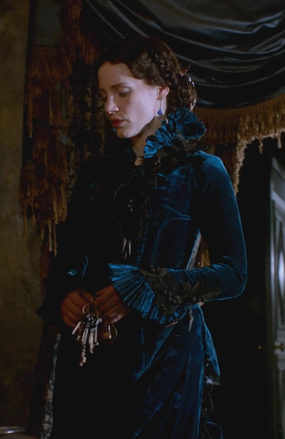
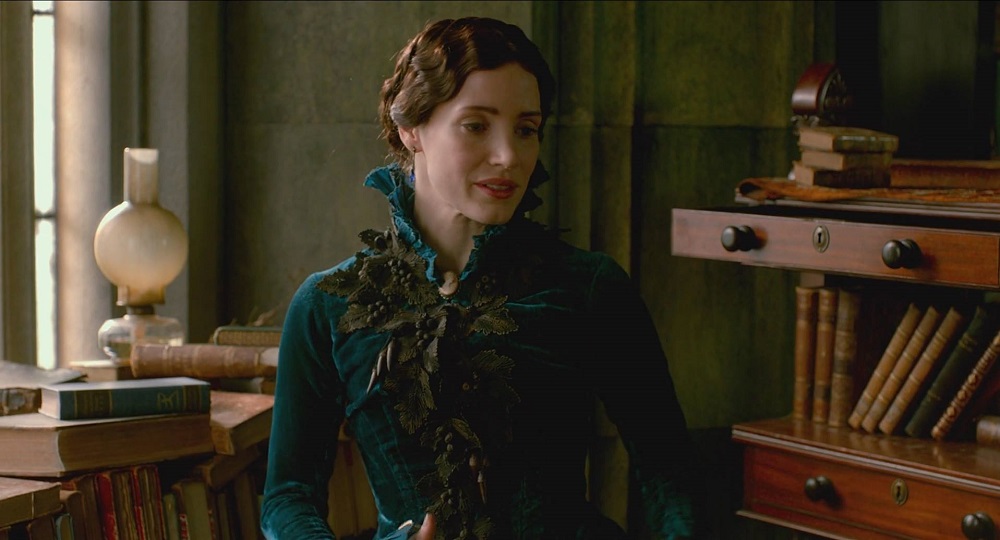
  • Costume design symbolism in Crimson Peak (2015): Lucille’s breathtaking blue velvet dress

    Costume design symbolism in Crimson Peak (2015): Lucille’s breathtaking blue velvet dress

    crimson-peak-lucille-blue-velvet-dress-symbolism

    Crimson Peak (2015), directed by Guillermo del Toro, is a visually stunning, gloomy cinematic horror spectacle, noted for its incredible and haunting aesthetic. A particularly remarkable and alluring feature of the intricate production design is Lucille’s breathtaking blue velvet dress. The bewitching symbolically-charged Victorian design of the dress includes a black garland resembling a vine with withered leaves, claustrophobically climbing towards her pale neck. The owner, played by the mesmerising Jessica Chastain, is a beautiful, tense, frigidly graceful corset-wearing ice queen filled with dark repressed emotions, whose attire reflects her inner state. Her blue, heavy rigid dress seems to blend with her eerie funereal surroundings, the underwater feeling given by the aquatic colours and the flickering interplay of light and darkness, the dark curtains, and the grandiose blue walls of the Gothic mansion. She is tragically connected to the ominous house and the dead vines tangled up around her body further anchor her in it, symbolising her psychological confinement. She is often shown in contrast to pure, innocent, and lively Edith, played by Mia Wasikowska, who wears light and loose gowns.

  • The adapted version of The Proust Questionnaire

    As a fan of Marcel Proust who loves the way he perceives the world as depicted in À la recherche du temps perdu, I thought I should write down my answers to the most popular version of his iconic questionnaire in my first unequivocally personal blog post, even though my answers may very well change tomorrow:

    What is your idea of perfect happiness?
    Time travel. Interplanetary travel. As for a slightly more down-to-earth answer, visiting the most beautiful, inspiring- ethereal or eerie- places, absorbing every moment spent there and feeling connected to the place, living in the present, and having a cultivated soul.

    What is your greatest fear?
    Death. Non-existence. Annihilation. Oblivion. Aging. Bugs.

    Which historical figure do you most identify with?
    Literary figures: Virginia Woolf & Sylvia Plath.

    Which living person do you most admire?
    Tilda Swinton. Richard Dawkins. David Lynch. Plus anyone who positively influences the world, who is aware of the whole picture and manages to focus on the good rather than the bad in the world, overall.

    What is the trait you most deplore in yourself?
    I will mention a few, although I have conflicting feelings about these traits as I don’t always deplore them: cynicism, the low-key need to be in control, fickleness in some respects, ricocheting between emotional frostiness and impulsiveness, scepticism to the point where I start being sceptical of my own scepticism, and taking myself too seriously (but otherwise I probably wouldn’t be able or feel propelled to write!).

    What is the trait you most deplore in others?
    Duplicity, hypocrisy. Prejudice. Lack of empathy and inability to listen. Arrogance. Wrong life values. Underestimating me.

    What is your greatest extravagance?
    My luxury perfume collection. Not sleeping at night.

    What is your favourite journey?
    towards self-awareness and self-development, through self-indulgence and creative fulfilment.

    What do you consider the most overrated virtue?
    Patience. Sympathy (not empathy). Contentment. Humility and prudence in women’s case. 

    On what occasion do you lie?
    When the conversation doesn’t matter, or when I’m convinced that telling the truth wouldn’t be beneficial to anyone involved. 

    Which living person do you most despise?
    anyone who uses their power to negatively influence, harm, ruin, or eradicate the lives of innocent people, either on an individual level, or on an organised level.

    Which words or phrases do you most overuse?
    aesthetic. surreal. oh my god. yeah. no.

    What is your greatest regret?
    caring when I shouldn’t have. not caring when I should have.

    What or who is the greatest love of your life?
    perfume, cinema, music, labyrinthine architecture

    When and where were you happiest?
    I don’t remember exactly but I’m gonna say it was probably a case of frisson- “aesthetic chills”- that I experienced whilst watching a hypnotic, revealing, or epiphany-inducing film or piece of art.

    Which talent would you most like to have?
    a mesmerising, emotion-inducing, magical singing voice.

    What is your current state of mind?
    introspective. conflicted.

    If you could change one thing about yourself, what would it be?
    I’d give myself an infinite dose of productivity and the capacity to love the world freely and unconditionally. Getting rid of grudges. Being less fickle/wishy-washy in some respects.

    What do you consider your greatest achievement?
    rising from the flames like a Phoenix.

    If you were to die and come back as a person or thing, what do you think it would be?
    a fairy or a nymph.

    What is your most treasured possession?
    my perfume collection, my films collection, my velvet dresses collection,

    What do you regard as the lowest depth of misery?
    not living the life you want, letting obsessions or demons consume you, feeling trapped.

    Where would you like to live?
    in a beautiful place adorned with paintings and different styles of decorations on each floor or in each room (Gothic, minimalist, dreamy, airy fantasy style etc). Also, in the distant future, maybe on a different, ultra-advanced planet. Either that or in one of the many film fantasy worlds I love.

    What is your favourite occupation?
    maladaptive daydreaming

    What is your most marked characteristic?
    being artistically-inclined. being headstrong, perceptive/astute, experiencing derealisation and zoning out (this sounds contradictory to the astuteness, but it’s actually not!); inquisitive, independent-minded, and a freethinker. looking sad or annoyed when I’m actually in a neutral or thoughtful mood.

    What is the quality you most like in a man?
    Intelligence (including emotional intelligence), genuineness, confidence -not cockiness, self-awareness

    What is the quality you most like in a woman?
    strength, genuineness, intelligence, confidence, self-awareness

    What do you most value in your friends?
    kindness, authenticity, having my best interests at heart, trustworthiness, & respecting confidentiality

    Who are your favourite writers?
    Virginia Woolf, Sylvia Plath, Baudelaire, Oscar Wilde, Vladimir Nabokov, Hermann Hesse

    Who is your favourite hero of fiction?
    Jessica Jones, Vanessa Ives, Jean des Esseintes, Violet Baudelaire, Rogue

    What do you dislike most about your appearance?
    I like my appearance overall, but there are two or three things I would/will probably change if I can.

    Who are your heroes in real life?
    Inspiring women who are unapologetically fierce and do whatever they feel like (unless they are psychopaths or something equally worrying).

    What are your favourite names?
    Morgana, Diana, Ariadna, Mordred, Crystal.

    What is it that you most dislike?
    pity, prejudice, labels.

    How would you like to die?
    Knowing that I will be revived as an immortal goddess, mostly because I want to live forever, but all the other perks would be fun too!

    What is your favourite motto?
    Do no harm, but take no shit. // C’est la vie. //
    Incantation-“You must not ever stop being whimsical. And you must not, ever, give anyone else the responsibility for your life.”
    Quotes-“I stopped explaining myself when I realised other people only understand from their level of perception.”
    “There are only two tragedies in life: one is not getting what one wants, and the other is getting it.”
    “Everything in moderation, including moderation.”
    “To love oneself is the beginning of a life-long romance”


    Write your own answers to all or some of these below, I’m interested to see!
  • Reflections on reading

    Published in Education in the Digital Era, March 2019

    Books are not only the arbitrary sum of our dreams, and our memory. They also give us the model of self-transcendence. […] They are a way of being fully human.”- Susan Sontag

    The multifaceted nature of literature encompasses an abundance of purposes when it comes to the act of reading, such as functioning as a vehicle of escapism, working as a tool to enhance self-awareness, setting in motion cultural and social change starting from individual transformation, inspiring metaphorical deaths and resurrections of selves, summoning childhood magic and nostalgia associated with books we grew up with and memories entangled with their reading, perceiving the human spirit as shaped through time within specific historical and cultural frameworks, as well as strengthening our connection with others by making us recognise ‘the other’ within us, and providing a mirror that we can use to face the world with empathy and acceptance as we fully acknowledge its realness and complexity.

    Reading can be seen as a spiritual journey, since it inspires a form of awakening. Stories we read during our formative years, during an early stage in our lives that is of utmost significance memory-wise, those stories will potentially remain the most enchanting reading experiences, because they enter our mind at a time when we tend to simply absorb every evocative image, every symbol, indiscriminately, unassumingly, with naivety and curiosity, and when simple yet vivid memories are formed. Later, as we mature and acquire more knowledge- not exclusively literary, whilst we learn to be more discerning, selective, as well as developing critical thinking, we are encouraged to deeply reflect on the strings of words in front of our eyes- sometimes, however, at the expense of the child-like wonder and the child’s way of seeing, of disappearing, and truly living within a story.

    While expressing her views on reading, Virginia Woolf emphasises that, whereas we should follow our instincts in reading rather than having someone else dictate the way in which we experience a literary piece, we should also avoid falling into the trap of projecting our pre-conceived ideas and judgements onto a piece of writing immediately, and instead, at first, decrease the volume of our critical voice in order to embrace the author’s voice and the creative process, to open our minds and let the thoughts of another flow into them. Afterwards, as cultivated readers, we can ponder on underlying themes and psychoanalytical symbolism, stylistic categorisations, meta-references, the larger aesthetic value of the work, character development, feminist interpretations and critiques, and the historical, socio-cultural, political or conceptual frameworks. As a Literature and Film graduate, I have found that temporarily tuning out certain aspects of this critical side that became a natural inclination in my reading is ideal if I wish to retain the pleasure of the act and to prevent disillusionment. Otherwise- and I have known Literature and Film students at university who faced such concerns- the enjoyment of a piece of writing or art in general might be diminished. When we let ourselves be fully engrossed by the words, something pure and beautiful happens: we disappear and live within a story, we allow ourselves to be bewitched by lyricism, to recognise the emotions evoked in a poem, to let them inspire us; we perceive and visualise the world conceived by another mind, unfolding within our own mind. That is when we can identify with a character, as well as finding traces of this character within ourselves, savouring every mental image, finding something interesting and revealing in every echo while devouring a good book. This way, we shift from clichés to something more intimate, from patterns of thinking to a unique taste of and insight into individual consciousness.

    During literary studies at university, our way of reading pieces of literature is, indeed, interestingly shaped, to a certain degree, by the modules we opt for and their structure, particularly the recommended critical interpretations and analysis of the works in question or, more broadly, of literary movements, periods, and other divisions. Once you place everything in a cultural, social, or historical context, or consider the psychoanalytical dimensions of a text, or interpret narratives from a feminist point of view, it can influence your process of experiencing other works and how you delve into them. This aspect is also facilitated by a tendency towards syntopical or comparative reading, which is recommended within an academic context- particularly in analysing critical theory books and essays- and rightfully so, since it is a useful tool for finding your own voice, forming your own opinions, gaining perspective, and developing critical thinking skills which are so essential in various areas of life. As a result, while reading prose fiction for instance, our minds may involuntarily jump to underlying commentaries and themes, paying more attention to connotations of nuances and how they fall into a wider sociocultural, ideological, or psychological framework. This may seem like a double-edged sword because it appears to be in contrast to the previous idea of experiencing a written story viscerally, intimately. However, as previously mentioned, the mind can be trained to read differently for pleasure, inspiration, or educational purposes and everyone can shift between different methods of reading.

    Placing a literary piece into the complex puzzle of history, can be particularly revealing and useful, for instance, when we read literature associated with silenced voices and with otherness: such literary works give us the chance to get an insight into the psyche of figures whose lives seem so distinct from ours and explore uncharted mental territories, an inner journey which will also prove to be self-revealing, whilst at the same time requiring transcendence. Reading can, indeed, often initiate us into a ritual of self-transcending. Language mediates our connection with our own selves as much as it mediates our connection with the world around us. Reading can be viewed as a process of merging contrasts: between temporality and atemporality, the tangible and the incorporeal, presence and absence, closeness and remoteness, self and other, the intimate and the universal, the evanescent and the eternal, a grasped world and an elusive one.

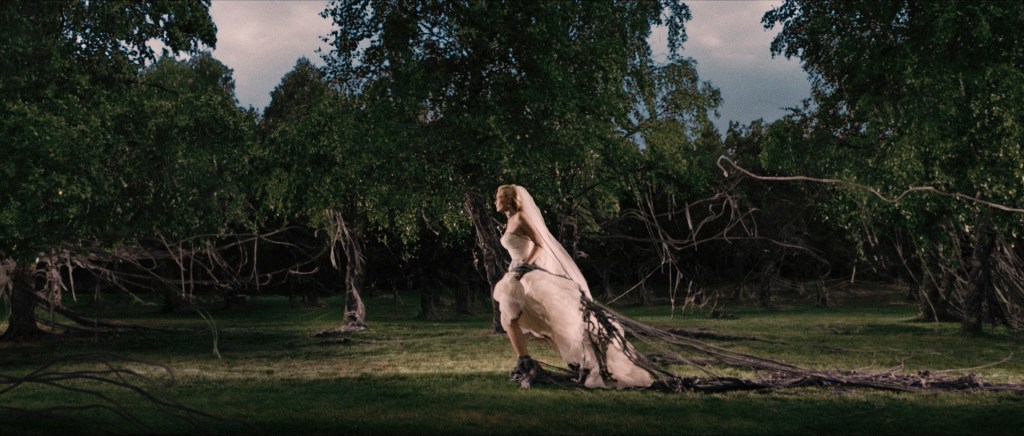
  • Film sequence analysis: Melancholia (2011) – the surreal overture

    Film sequence analysis: Melancholia (2011) – the surreal overture

    The opening sequence of Melancholia (2011, Lars von Trier), a collection of gloomy, surreal, painting-resembling, slow-motion shots, is an insidious introduction to the themes of this compelling cinematic symphony of death and destruction. What completes the eerie dreamscape is the exquisite, haunting piece of music by Wagner – the Prelude to the tragic opera Tristan und Isolde, which magnifies the sorrow depicted in the shots and throughout the whole film. The film and the opera both exhibit the philosophical pessimism of Schopenhauer, revolving around unhappiness, death, and painful, unfulfilled human yearning. The nocturnal landscape, the Realm of the Night from Wagner’s opera, symbolically stands for the realm of hidden truth; and the only escape or redemption from a world perceived as evil and relentlessly suffering, is spiritual release, death, hence Justine’s morbid Ophelia moment and the early appearance of the destructive planet, “Melancholia”. The deadly planet, with its suggestive name, is a metaphor most beautifully conveyed visually when Justine, the perpetually despondent and apathetic bride, bathes naked in its light and is shown yearning for its life-threatening touch, on the same musical notes from the Prelude. Death appears in other forms in von Trier’s haunting cinematic overture as well, such as the striking nightmarish image of the dead birds falling from the sky in the background whilst Justine’s cold blank face is shown in a close-up shot; or the horse collapsing backwards in bleak surroundings. Another memorable surreal image is that of a fascinated Justine staring at her fingertips as they seem to be connected to the bolts of lightning.

    Within the themes and the atmosphere of Melancholia, we can also find echoes of Wagner’s own beautifully dark poetic words about Tristan und Isolde, once again resonating with Schopenhauer’s philosophy. He describes the tragic story as “a tale of endless yearning, longing, the bliss and wretchedness of love; world, power, fame, honour, chivalry, loyalty, and friendship all blown away like an insubstantial dream; one thing left living – longing, longing unquenchable, a yearning, a hunger, a languishing forever renewing itself; one sole redemption – death, finality, a sleep without awakening…”

  • Train of thought

    You said to yourself that it was too cold and that was why you could barely function. It was either that, or the weeks-long stagnation of the spirit.

    One day you will no longer think of your own passing, or that of those closest to you, no longer delving in scenarios of unhappiness out of masochistic urges, or in abyssal streams of consciousness.

    The city, oh, the city. Sometimes you are the city, sometimes the city is in you, sometimes the city does not exist, or is something so detached from who you are, even as you pass right through its heart. The city in daylight and the city at night – such peculiar dualism to which your mindset adjusts, and which appeals to different beings within you, with different dreams and different nightmares.

    You need success and fulfilment in order to open up. Is it right? It might be ingrained – inherited or caused by nurture. Unfolding at your most vulnerable seems impractical anyway, what a silly thing to do. Put up walls and let flowers climb them.

    I ate everything I had in the house -red and purple fruits and chocolate, then I took the first train and stopped at the station where my train of thought decided to let me go. The station was all empty, I smiled to myself, and nature witnessed. There is a journey ahead.